
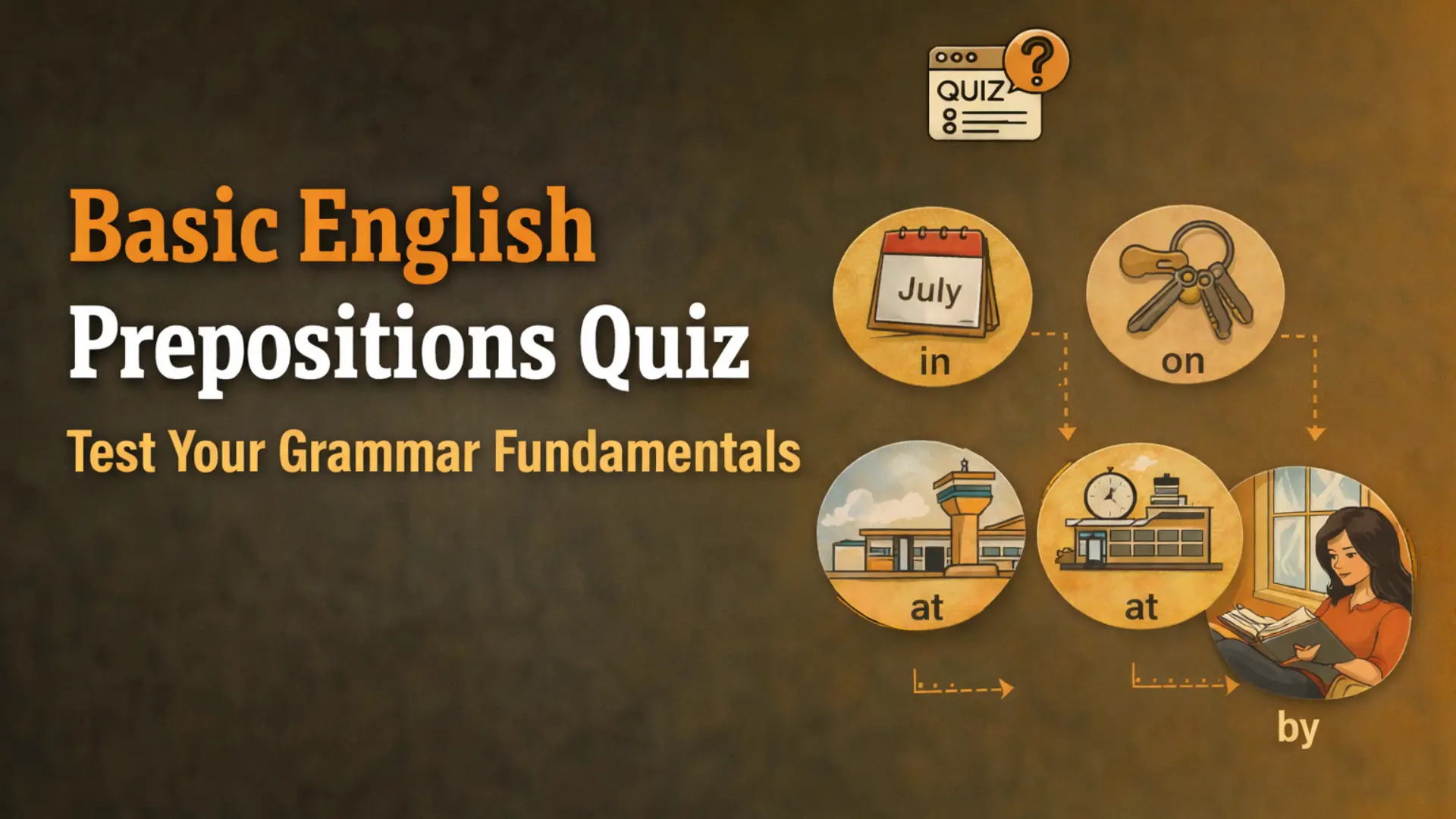
Have you ever written a sentence and thought — wait, should that be in or on? At or by? If yes, you are in the right place!
Prepositions are small words, but they carry a lot of weight in English. A tiny mix-up between in, on, at, or by can make your sentence sound unnatural — even if everything else is perfect. The good news? These mistakes are completely fixable with a little practice.
This quiz is designed for anyone who wants to get confident with basic English prepositions. Whether you are a beginner just starting out or someone who has been learning English for years, this quick 10-question quiz will show you exactly where you stand.
Here is what makes this quiz worth your time:
- ✅ 10 carefully chosen real-life sentences
- ✅ Instant feedback after every answer
- ✅ Clear explanations so you understand the why, not just the what
- ✅ A handy study guide to keep as a reference
No pressure, no timer — just you, your grammar instincts, and a chance to level up.
So go ahead — scroll down, take the quiz, and find out how strong your preposition game really is. You might surprise yourself! 😊
📚Complete Study Guide
IN – Months, Years & Parts of Day
Use 'in' with months, years, seasons, and parts of the day. It refers to a longer or general period of time, not a specific point.
Formula: in + month / year / season / part of day
✓ She was born in July
✓ I will see you in the evening
✓ He was born in 1995
✗ She was born on July (incorrect)
Think of IN as being inside a large block of time — a month, a year, a season. If the time period has size and length, use IN.
AT – Specific Times & Exact Places
Use 'at' with specific clock times and precise locations like stops, stations, and venues. AT points to an exact moment or spot — not a general area.
Formula: at + specific time / exact location
✓ The meeting is at 10 a.m.
✓ She arrived at the airport early
✓ We met at the bus stop
✗ The meeting is on 10 a.m. (incorrect)
Think of AT as a sharp pin on a map or clock — it marks one exact point. If you can point to it precisely, use AT.
ON – Days & Surfaces
Use 'on' with specific days of the week, dates, and surfaces. ON refers to a named day or something physically resting on top of a surface.
Formula: on + day of the week / date / surface
✓ We have a holiday on Monday
✓ The keys are on the table
✓ The picture is on the wall
✗ We have a holiday in Monday (incorrect)
ON is a flat preposition — think of it as things sitting ON top of a surface or landing ON a specific day. If it is a named day or a flat surface, it is ON.
IN – Cities, Countries & Enclosed Spaces
Use 'in' when referring to a location that has boundaries or area — like a city, country, room, or building. You are inside the space, not just at a point.
Formula: in + city / country / enclosed space
✓ He lives in Mumbai
✓ She works in a hospital
✓ They are in the office right now
✗ He lives at Mumbai (incorrect)
IN Mumbai = you are inside the city. AT Mumbai = sounds like a station stop. For cities and countries you call home or live in, always use IN.
Good AT – Describing a Skill
Use 'at' after 'good' when describing someone's skill or ability in a subject or activity. This is a fixed adjective-preposition collocation and does not change.
Formula: good + AT + subject / skill / activity
✓ He is good at math
✓ She is good at drawing
✓ Are you good at public speaking?
✗ He is good in math (incorrect)
Good AT = skilled in something. Good FOR = beneficial for something. Example — Exercise is good FOR your health. These are two very different meanings!
ON – Walls & Vertical Surfaces
Use 'on' when something is attached to, hung on, or displayed on a surface — including vertical surfaces like walls. The surface does not have to be horizontal for ON to apply.
Formula: on + wall / board / screen / surface
✓ The picture is on the wall
✓ The notice is on the board
✓ There is a crack on the ceiling
✗ The picture is in the wall (incorrect)
Whether horizontal like a table or vertical like a wall — if something is touching and resting against a surface, ON is your answer. IN the wall would mean it is buried inside it!
AT – Transport Hubs & Meeting Points
Use 'at' with transport locations such as airports, stations, bus stops, and terminals. These are treated as specific points or venues, not areas you are inside.
Formula: at + airport / station / bus stop / terminal
✓ She arrived at the airport early
✓ We met at the bus stop
✓ He is waiting at the train station
✗ She arrived in the airport early (incorrect)
While you can say 'in the airport' when referring to being inside the building, 'arrived at the airport' is the standard and natural expression. AT is used for arrival and meeting points.
IN vs ON vs AT – Time Summary
All three prepositions are used for time but at different levels. Think of them as a zoom lens — IN is wide, ON is mid, AT is precise.
Formula: IN + long period | ON + specific day/date | AT + exact time
✓ She was born in July (month → IN)
✓ We have a holiday on Monday (day → ON)
✓ The meeting is at 10 a.m. (exact time → AT)
✗ The meeting is in 10 a.m. (incorrect)
Zoom OUT for IN — big time like months and years. Zoom to a day for ON — named days and dates. Zoom IN sharp for AT — exact clock times. This one rule covers most time preposition questions!
You just levelled up your preposition game — don’t stop here! 💪
The best English learners stay consistent, and the easiest way to do that is with the ClipYourEnglish Newsletter. Fresh grammar tips and practice — delivered to your inbox every single week.
New subscribers also get the “Idiom Toolbox” eBook for free — packed with everyday idioms your textbook never taught you.
Join thousands of learners already growing with ClipYourEnglish.
👉 Subscribe free and grab your eBook today!
⚡ Continue Learning
Grammar Quizzes- Preposition Collocations Quiz – Do You Know Which Preposition Fits?
- Adverbs Quiz: Test How Well You Use Adverbs in English (10 Questions)
- Intermediate English Prepositions Quiz – How Well Do You Know Your Grammar?
- Advanced English Grammar Quiz with Answers (C1–C2 Level)
- Intermediate Phrasal Verbs Quiz – How Many Can You Get Right?
