
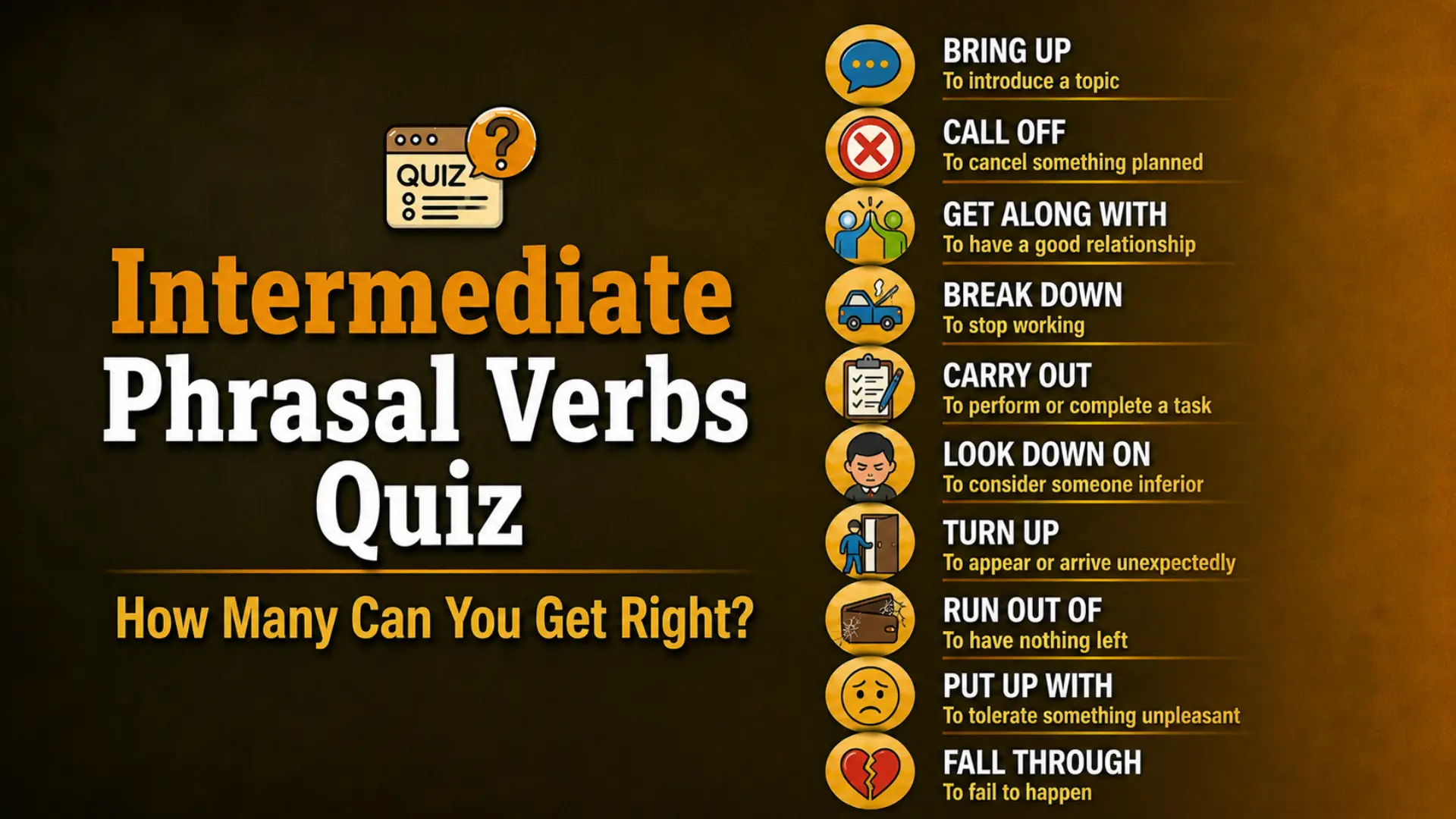
Do you find phrasal verbs confusing? You’re definitely not alone! Phrasal verbs are one of the trickiest parts of learning English — and yet they show up everywhere in daily conversations, emails, and even movies. That’s why this phrasal verbs quiz is exactly what you need right now.
If you’ve already tried our Phrasal Verbs Quiz for Beginners, great job! It’s time to level up. This Phrasal Verbs Quiz Part 2 brings you 10 carefully picked questions covering some of the most common phrasal verbs used in real-life English. From breaking down to putting up with, this quiz covers the ones that every English learner must know.
Each question comes with 3 options, a correct answer, and a clear explanation — so you don’t just guess, you actually learn. And if you really want to push your grammar to the next level, don’t miss our Advanced Sentence Structure Quiz after this!
Ready to find out how many you can get right? Scroll down, take the quiz, and don’t forget to check your score at the end. Let’s go!
📚 Phrasal Verbs Quiz: Complete Study Guide
Master these 10 essential phrasal verbs and take your everyday English to the next level. Each entry includes meaning, real-life examples, and practical tips to help you use them naturally in conversations, writing, and exams.
BRING UP – Introduce a Topic
'Bring up' means to introduce a subject or topic into a conversation. It is used when someone starts talking about something that wasn't being discussed before.
Common Collocations: bring up + a topic / an issue / a point / a concern / a problem
✓ She brought up the salary issue during the meeting.
✓ He always brings up old arguments during discussions.
✗ She closed up the salary issue. (closed up = ended it — opposite meaning)
✗ She avoided up the salary issue. (grammatically incorrect — avoid doesn't pair this way)
'Bring up' has two common meanings — to introduce a topic AND to raise a child. Context is everything! 'She was brought up in London' = she was raised there. 'She brought up the issue' = she introduced it in conversation.
CALL OFF – Cancel Something Planned
'Call off' means to cancel an event, meeting, or plan that was already scheduled. It is commonly used in both formal and informal English.
Common Collocations: call off + a meeting / an event / a strike / a wedding / a search
✓ The outdoor concert was called off due to heavy rain.
✓ The union called off the strike after negotiations succeeded.
✗ The concert was called on due to heavy rain. (called on = asked someone to speak — opposite effect)
✗ The concert was called up due to heavy rain. (called up = to phone someone — wrong meaning)
Call off vs Postpone. 'Call off' = cancel completely. 'Postpone' = delay to a later date. Example: 'The match was called off' means it won't happen at all. 'The match was postponed' means it will happen later. These two are commonly confused!
GET ALONG WITH – Have a Good Relationship
'Get along with' means to have a friendly, positive, and harmonious relationship with someone. It describes how well people coexist or interact with each other.
Common Collocations: get along with + colleagues / friends / family / neighbours / classmates
✓ She gets along with all her colleagues at work.
✓ It's important to get along with your neighbours.
✗ She gets against with all her colleagues. (grammatically incorrect — no such phrasal verb)
✗ She falls out with all her colleagues. (falls out with = argues and stops being friends — opposite meaning)
'Get along with' and 'get on with' mean the same thing in British English. Example: 'Do you get on with your manager?' Both are correct and widely used. In American English, 'get along with' is more common.
BREAK DOWN – Stop Working
'Break down' means to stop functioning properly — used for machines, vehicles, or equipment. It can also describe a person becoming emotionally overwhelmed or a situation collapsing.
Common Collocations: break down + car / machine / system / negotiations / relationship
✓ Our car broke down on the motorway last night.
✓ Negotiations between the two sides broke down completely.
✗ Our car broke up on the motorway. (broke up = ended a relationship or split into pieces)
✗ Our car broke off on the motorway. (broke off = detached something — different meaning)
'Break down' is a versatile phrasal verb. Machine: 'The printer broke down.' Emotions: 'She broke down and cried.' Data: 'Let me break down the figures for you' (= explain in detail). Knowing all uses makes your English sound truly natural!
CARRY OUT – Perform or Complete a Task
'Carry out' means to perform, complete, or execute a task, plan, or instruction. It is widely used in formal, academic, and professional English.
Common Collocations: carry out + an experiment / research / a plan / instructions / a task / an investigation
✓ The scientists carried out a series of experiments.
✓ The police carried out a thorough investigation.
✗ The scientists carried off a series of experiments. (carried off = won a prize or pulled off something difficult)
✗ The scientists carried on a series of experiments. (carried on = continued — slightly different meaning)
'Carry out' is preferred in academic and professional writing over casual alternatives. Instead of 'do a test', say 'carry out a test'. Instead of 'do research', say 'carry out research'. This small upgrade makes your writing sound significantly more professional.
LOOK DOWN ON – Consider Someone Inferior
'Look down on' means to regard someone as less important, less intelligent, or of lower status than yourself. It carries a negative tone and implies arrogance or disrespect.
Common Collocations: look down on + people / others / colleagues / those who / someone for
✓ He looks down on people who didn't go to university.
✓ Nobody likes a person who looks down on others.
✗ He looks up to people who didn't go to university. (looks up to = admires — complete opposite meaning)
✗ He looks after people who didn't go to university. (looks after = takes care of — different meaning)
'Look down on' vs 'Look up to' — these are perfect opposites and commonly tested in English exams. Look down on = disrespect. Look up to = admire and respect. Example: 'She looks up to her mentor but looks down on lazy colleagues.'
TURN UP – Appear or Arrive Unexpectedly
'Turn up' means to arrive or appear somewhere, often without prior notice or when least expected. It can also mean to increase the volume or intensity of something.
Common Collocations: turn up + unexpectedly / late / uninvited / at an event / out of nowhere
✓ He turned up at the party without an invitation.
✓ She turned up two hours late without any explanation.
✗ He turned down at the party without an invitation. (turned down = rejected something — opposite meaning)
✗ He turned off at the party. (turned off = switched something off — wrong meaning)
'Turn up' can mean to arrive unexpectedly: 'He just turned up at my door!' OR to increase volume/heat: 'Can you turn up the music?' Context will always make the meaning clear. Both uses are very common in everyday spoken English.
RUN OUT OF – Have Nothing Left
'Run out of' means to use up all of something so that none remains. It expresses the idea of a supply or resource being completely exhausted.
Common Collocations: run out of + time / money / patience / ideas / fuel / stock / options
✓ We ran out of milk so I went to the supermarket.
✓ The team ran out of ideas halfway through the project.
✗ We ran into milk. (ran into = encountered something or someone — wrong meaning)
✗ We ran over milk. (ran over = drove over something — completely wrong context)
'Run out of' is always followed by a noun — never a verb. ✓ 'Run out of time' ✓ 'Run out of money' ✗ 'Run out of to study'. Also note: you can say 'We've run out' without specifying what — if the context is already clear to both speakers.
PUT UP WITH – Tolerate Something Unpleasant
'Put up with' means to accept or tolerate an unpleasant situation, behavior, or person without complaining. It implies patience, often under difficult or frustrating circumstances.
Common Collocations: put up with + noise / behavior / rudeness / a situation / someone's attitude
✓ I can't put up with the noise from next door any longer.
✓ She put up with his bad behavior for years before leaving.
✗ I can't put down with the noise. (put down = criticise or place something — incorrect structure)
✗ I can't put off with the noise. (put off = postpone or disgust — wrong phrasal verb)
In formal writing, instead of 'put up with', use 'tolerate' or 'endure'. Example: 'The staff could no longer tolerate the working conditions.' However, in spoken English and informal writing, 'put up with' is far more natural and commonly used. Know both!
FALL THROUGH – Fail to Happen
'Fall through' means that a plan, deal, or arrangement fails to be completed or doesn't happen as expected. It implies disappointment as something that seemed certain did not work out.
Common Collocations: fall through + a deal / a plan / an arrangement / a project / negotiations
✓ Our holiday plans fell through because of the visa rejection.
✓ The business deal fell through at the last minute.
✗ Our holiday plans fell apart because of the visa rejection. (fell apart = broke into pieces or became chaotic — slightly different nuance)
✗ Our holiday plans fell out because of the visa rejection. (fell out = had an argument — wrong meaning entirely)
Fall through vs Fall apart vs Fall out. 'Fall through' = a plan fails to happen. 'Fall apart' = something collapses or breaks down completely. 'Fall out' = people have an argument and stop being friends. These three are commonly confused — knowing the difference puts you ahead!
⚡ Continue Learning
Grammar Quizzes- Confusing Prepositions Quiz – Can You Pick the Right One?
- Adverbs Quiz: Test How Well You Use Adverbs in English (10 Questions)
- Basic English Tenses Quiz: Can You Score 10/10?
- Phrasal Verbs Quiz for Beginners – How Many Can You Get Right?
- Present Perfect vs Past Simple Quiz: Test Your English Grammar Skills
