
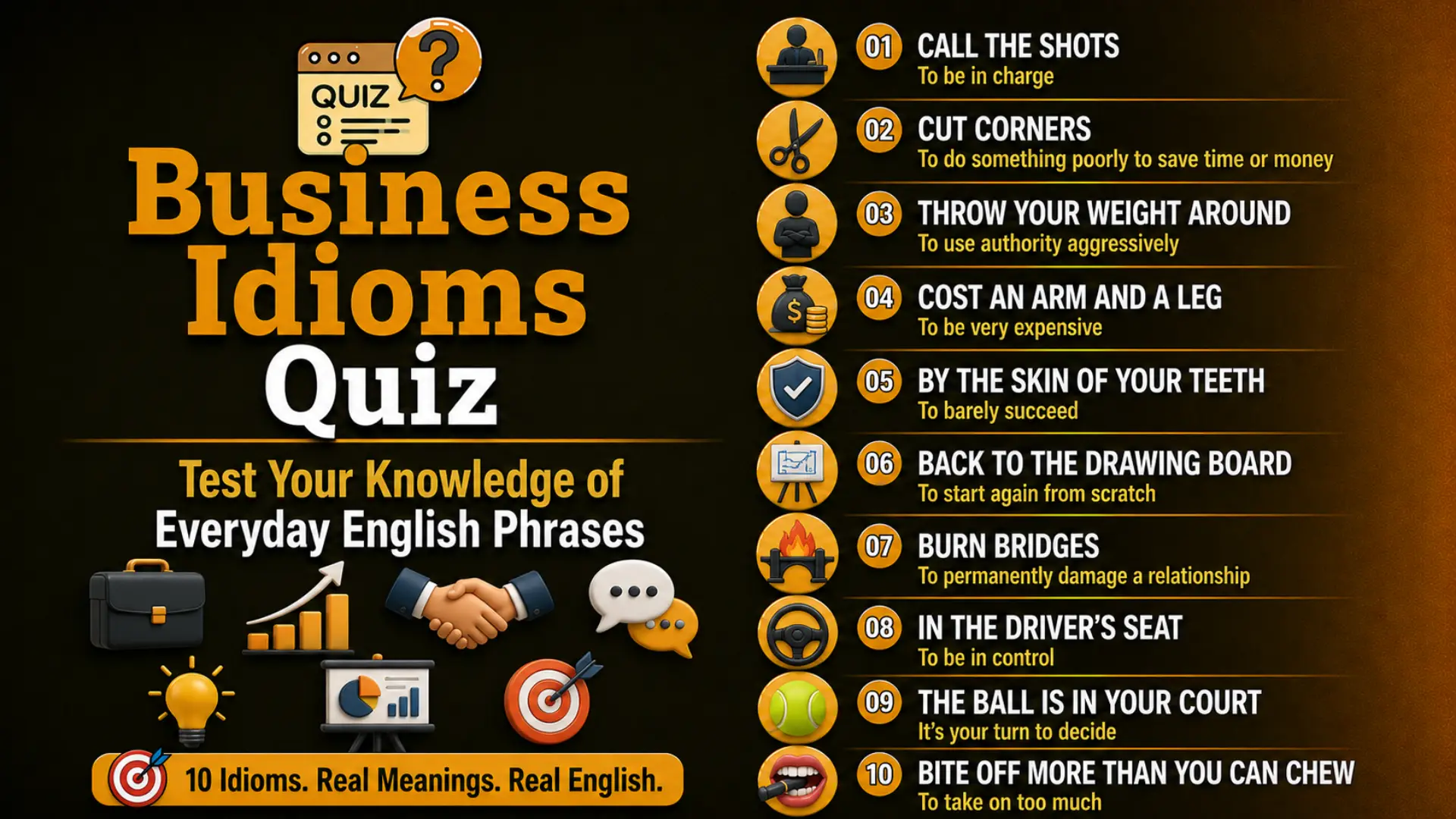
Think you know your English idioms? Take this business idioms quiz and find out! Idioms are everywhere — in the office, in conversations, in movies, and even in daily life. But if you don’t know what they mean, they can be really confusing! Phrases like “call the shots” or “burn bridges” don’t mean what they literally say — and that’s exactly what makes them tricky.
This business idioms quiz is designed for English learners who want to sound more natural and confident in real-life situations. Whether you’re preparing for a job interview, talking to colleagues, or just watching an English series, knowing these idioms will make a huge difference.
Before you jump in, if you haven’t already tested yourself on grammar patterns, check out our Comparative Sentences Quiz 1 and Comparative Sentences Quiz 2 — they’re great warm-ups for today’s challenge!
In this quiz, you’ll get 10 carefully picked idiom questions, each with 3 options and a clear explanation after every answer. You won’t just guess the right answer — you’ll actually learn the meaning and how to use it in real life.
So, are you ready to level up your English? Scroll down, start the business idioms quiz, and let’s see how many you can get right!
📚 Business Idioms Quiz: Complete Study Guide
Master these 10 essential business idioms used in real workplaces, conversations, and everyday life. Each expression includes meaning, examples, and practical tips to help you use them naturally and confidently.
CALL THE SHOTS – To Be in Charge
'Call the shots' means to be the person who makes the important decisions. It describes someone who is in authority or in control of a situation.
Common Collocations: call the shots + in a company / in a meeting / in a relationship / at work
✓ The CEO calls the shots in this organization.
✓ She's the one calling the shots — don't make a move without asking her.
✗ The CEO follows the shots. (incorrect — opposite meaning)
✗ The CEO ignores the shots. (makes no sense with this idiom)
Don't confuse 'call the shots' with 'call it a day' (to stop working) or 'call the bluff' (to challenge someone). 'Call the shots' is always about decision-making power. You'll often hear it in business meetings and leadership discussions.
CUT CORNERS – To Do Something Poorly to Save Time or Money
'Cut corners' means to do something in the quickest or cheapest way, often by skipping important steps. It usually carries a negative tone — suggesting the quality has been sacrificed.
Common Collocations: cut corners + on safety / on quality / on costs / during production
✓ They cut corners on safety to finish the building on time.
✓ If you cut corners during revision, don't expect good results.
✗ They improved corners on safety. (incorrect — does not make sense)
✗ They expanded corners on quality. (incorrect — wrong usage)
Cutting corners ≠ being efficient. Efficiency means doing things well in less time. Cutting corners means skipping important steps and risking quality. In professional English, this idiom often implies criticism or warning.
THROW YOUR WEIGHT AROUND – To Use Authority Aggressively
'Throw your weight around' means to use your power, influence, or authority in an aggressive or bossy way. It often suggests the person is being unreasonable or intimidating.
Common Collocations: throw weight around + in the office / with colleagues / at meetings / as a manager
✓ The new director loves to throw his weight around in team meetings.
✓ Don't throw your weight around just because you got a promotion.
✗ The director loves to lift his weight around. (incorrect — wrong verb)
✗ The director loves to share his weight around. (incorrect — changes the meaning entirely)
This idiom is almost always used negatively. If someone is 'throwing their weight around,' it means people around them feel pressured or uncomfortable. It is different from being confident or assertive — it implies abuse of power.
COST AN ARM AND A LEG – To Be Very Expensive
'Cost an arm and a leg' is used to describe something that is extremely expensive — far beyond what seems reasonable. It exaggerates the price to show how costly something is.
Common Collocations: cost an arm and a leg + to buy / to repair / to maintain / to travel
✓ That sports car costs an arm and a leg — I could never afford it.
✓ Travelling business class costs an arm and a leg.
✗ That car costs a hand and a foot. (incorrect — this is not the correct idiom form)
✗ That car costs a finger and a toe. (incorrect — the fixed expression must not be changed)
This is a fixed idiom — you cannot change the words. It must always be 'arm and a leg', never 'hand and a foot' or any other body parts. Fixed idioms must be memorized exactly as they are.
BY THE SKIN OF YOUR TEETH – To Barely Succeed
'By the skin of your teeth' means to only just manage to do something or escape something — with almost no margin to spare. It describes a very narrow success or escape.
Common Collocations: pass / escape / win / survive + by the skin of your teeth
✓ She passed her driving test by the skin of her teeth — just one mark above the pass mark.
✓ We caught the last train by the skin of our teeth.
✗ She passed her test by the width of her hair. (incorrect — not a real idiom)
✗ She passed her test by the edge of her nail. (incorrect — fixed expression must not be altered)
This idiom is used when someone succeeds but only barely — the situation was very close to failing. It is commonly used in storytelling and informal conversation. Pair it with verbs like pass, escape, win, or survive for the most natural usage.
BACK TO THE DRAWING BOARD – To Start Again from Scratch
'Back to the drawing board' means that a plan has failed and you need to start completely from the beginning with a new idea or approach. The phrase comes from the literal idea of going back to draw a new design.
Common Collocations: go back / it's back + to the drawing board + after failure / rejection / a setback
✓ The client rejected our proposal, so it's back to the drawing board.
✓ The product launch failed — the whole team is back to the drawing board.
✗ It's back to the writing board. (incorrect — the fixed phrase uses 'drawing board')
✗ It's back to the planning table. (incorrect — a different phrase with different usage)
Use this idiom when a plan, project, or idea has clearly failed and a fresh start is needed. It is commonly used in business, design, and project management contexts. It signals not just failure — but the willingness to try again.
BURN BRIDGES – To Permanently Damage a Relationship
'Burn bridges' means to permanently destroy a relationship or opportunity, making it impossible to go back. The image is of literally burning a bridge behind you — so there is no way to return.
Common Collocations: burn bridges + with colleagues / with employers / in business / after leaving a job
✓ Always leave a job professionally — never burn bridges with former employers.
✓ His angry resignation letter burned every bridge he had in the industry.
✗ Always build bridges with former employers. (opposite meaning — 'build bridges' means to create connections)
✗ Always cross bridges with former employers. (incorrect — 'cross that bridge' is a different idiom)
The opposite of 'burn bridges' is 'build bridges' — which means to create positive connections and relationships. Knowing idiom opposites helps you use them more accurately and naturally in both speaking and writing.
IN THE DRIVER'S SEAT – To Be in Control
'In the driver's seat' means being in a position of control, power, or authority over a situation. Just like a driver controls the direction of a car, this person controls the direction of events.
Common Collocations: be / sit / put someone + in the driver's seat + of negotiations / of the project / of one's career
✓ After winning the contract, the company is firmly in the driver's seat.
✓ You need to take charge and put yourself in the driver's seat of your own career.
✗ After winning the contract, the company is in the passenger's seat. (opposite — being passive, not in control)
✗ After winning the contract, the company is in the back seat. (incorrect — 'back seat' means having less control)
'Take a back seat' means the opposite — to give up control or become less involved. Knowing related idioms as a pair (driver's seat vs back seat) makes it much easier to remember and use both correctly.
THE BALL IS IN YOUR COURT – It's Your Turn to Decide
'The ball is in your court' means that it is now the other person's turn to take action or make a decision. The responsibility has shifted to them. It comes from tennis, where the ball literally moves from one side of the court to the other.
Common Collocations: the ball is in + your / their / his / her + court + now / to decide / to respond
✓ I've sent the offer — the ball is in their court now.
✓ We've done everything we can. The ball is in your court.
✗ The ball is in your field. (incorrect — 'field' is not used in this idiom)
✗ The ball is in your ground. (incorrect — fixed idiom must use 'court')
This idiom always follows the pattern: 'The ball is in [someone's] court.' You can change the pronoun (your, their, his, her) but never the rest of the phrase. It is very commonly used in business negotiations and everyday conversations about decisions.
BITE OFF MORE THAN YOU CAN CHEW – To Take On Too Much
'Bite off more than you can chew' means to take on a task, responsibility, or commitment that is too large or too difficult to manage. The image comes from taking a bite of food that is too big to chew comfortably.
Common Collocations: bite off more than you can chew + with a project / a commitment / responsibilities / deadlines
✓ He bit off more than he could chew by accepting three jobs at the same time.
✓ Don't bite off more than you can chew — focus on one project at a time.
✗ He swallowed more than he could chew. (incorrect — the verb must be 'bite off', not 'swallow')
✗ He ate more than he could chew. (incorrect — fixed expression requires 'bite off')
This idiom is not just about failure — it is a warning about overcommitment. It is commonly used as friendly advice: 'Don't bite off more than you can chew.' It is also widely used in workplace conversations, career planning, and self-development discussions.
⚡ Continue Learning
Quiz- Adverbs Quiz: Test How Well You Use Adverbs in English (10 Questions)
- Synonym and Antonym Quiz: Test Your English Vocabulary Skills
- Comparative Sentences Quiz: Test Your English Grammar!
- Advanced English Grammar Quiz with Answers (C1–C2 Level)
- Intermediate Phrasal Verbs Quiz – How Many Can You Get Right?
