
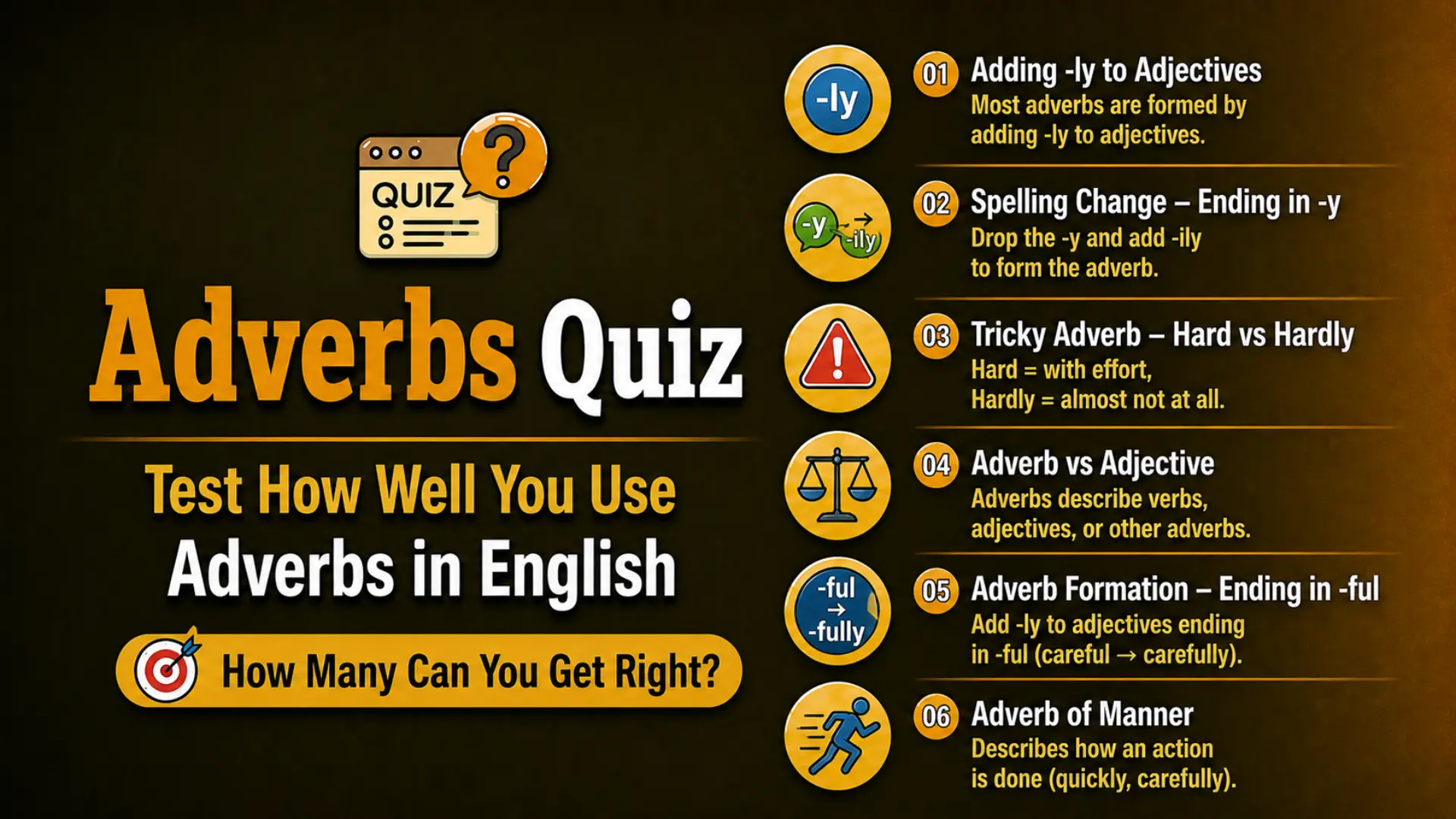
Do you know when to say “She speaks fluent” or “She speaks fluently”? If you’re not sure, this adverbs quiz is exactly what you need! Adverbs are one of those grammar topics that seem simple at first — but they can really trip you up when you’re speaking or writing in English.
Many English learners confuse adverbs with adjectives, especially when describing actions. A small mistake like saying “He drives careful” instead of “He drives carefully” can make your English sound unnatural — even if the rest of your sentence is perfect. The good news? With a little practice, adverbs become second nature!
Before you jump into this quiz, if you haven’t already, check out our Common Grammar Errors Quiz — it covers mistakes that most English learners make every day. You might also enjoy our Confusing Words Quiz to sharpen your vocabulary skills alongside your grammar.
Now, back to adverbs! This adverbs quiz is designed for learners at every level — whether you’re a beginner just getting started or an intermediate learner looking to polish your grammar. It features 10 carefully selected questions with three answer choices each. After every question, you’ll get a clear explanation so you don’t just pick the right answer — you actually understand why it’s correct.
No pressure, no timer — just you, the quiz, and a chance to level up your English grammar. By the end, you’ll have a much better feel for how adverbs work in real sentences.
So, are you ready to find out how well you really know your adverbs? Scroll down and take the quiz now — let’s see how you do!
📚 Adverbs Quiz: Complete Study Guide
Master these 10 essential adverb rules and use them correctly in everyday English. Each section includes the grammar rule, real examples, and practical tips to help you avoid the most common adverb mistakes in speaking and writing.
ADVERB RULE – Adding -ly to Adjectives
Most adverbs are formed by adding -ly to an adjective. Adverbs describe how, when, where, or to what extent an action is done. They modify verbs, adjectives, or other adverbs.
Common Pattern: adjective + -ly → adverb
fluent → fluently | careful → carefully | soft → softly | patient → patiently
✓ She speaks English . (how she speaks)
✓ He drives very carefully. (how he drives)
✗ She speaks English fluent. (fluent is an adjective — wrong here)
✗ He drives very careful. (careful describes a noun, not a verb)
Ask yourself — does the word describe a noun (adjective) or a verb/action (adverb)? If it answers "How?", you need an adverb ending in -ly. Example: "She sings beautiful" ✗ → "She sings beautifully" ✓
SPELLING CHANGE – Adjectives Ending in -y
When an adjective ends in -y, drop the -y and add -ily to form the adverb. This is a very common spelling pattern that many learners get wrong.
Common Pattern: adjective ending in -y → drop -y + add -ily
easy → easily | happy → happily | heavy → heavily | busy → busily
✓ He completed the task . (easy → easily)
✓ She smiled happily at the news. (happy → happily)
✗ He completed the task easy. (adjective used incorrectly as adverb)
✗ He completed the task easly. (common misspelling — missing the i)
Think of it as a chain — easy → easi → easily. Whenever you see an adjective ending in -y, always swap the -y for -ily when making an adverb. No exceptions for this pattern!
TRICKY ADVERB – Hard vs Hardly
Some words look like they follow the -ly adverb pattern but actually have a completely different meaning when -ly is added. Hard and Hardly are one of the most confusing pairs in English.
Hard (adverb) = with a lot of effort or force
Hardly (adverb) = almost not at all / scarcely
✓ They worked . (they put in a lot of effort)
✓ They hardly worked. (they did almost no work — opposite meaning!)
✗ They worked hardly. (grammatically wrong AND changes the meaning entirely)
✗ I can believe it. (should be "hardly" — "hard" doesn't work here)
Other similar tricky pairs include: late → lately (late = not on time | lately = recently), near → nearly (near = close | nearly = almost). Always check the meaning — adding -ly doesn't always just make an adverb, it can create a whole new word!
ADVERB vs ADJECTIVE – Know the Difference
Adjectives describe nouns. Adverbs describe verbs, adjectives, or other adverbs. The most common mistake learners make is using an adjective where an adverb is needed — especially after action verbs.
Formula: Subject + Action Verb + Adverb (NOT adjective)
She answered + correctly ✓ | He runs + quickly ✓ | The baby slept + peacefully ✓
✓ She answered the question . (adverb — describes how she answered)
✓ She is a correct person. (adjective — describes the noun 'person')
✗ She answered the question correct. (adjective used wrongly after an action verb)
✗ She answered the question correction. (noun — cannot be used here at all)
After an action verb, always ask — "How did they do it?" The answer is always an adverb. Example: "He spoke softly" — How did he speak? Softly. If the word answers "What kind?", it's an adjective and belongs near a noun, not a verb.
ADVERB FORMATION – Adjectives Ending in -ful
Adjectives ending in -ful form adverbs by simply adding -ly at the end. This is a very consistent and reliable pattern in English — no spelling changes needed except adding -ly.
Common Pattern: adjective (-ful) + ly → adverb (-fully)
careful → carefully | peaceful → peacefully | beautiful → beautifully | hopeful → hopefully
✓ The baby slept . (peaceful + ly)
✓ She sings beautifully. (beautiful + ly)
✗ The baby slept peaceful. (adjective — cannot describe the verb 'slept')
✗ She sings beauty. (noun — completely wrong word class)
Once you know this pattern, you unlock dozens of adverbs instantly! careful → carefully | graceful → gracefully | powerful → powerfully | wonderful → wonderfully. Adjectives ending in -ful ALWAYS form adverbs with -fully. No exceptions!
ADVERB OF MANNER – Describing How Actions Are Done
Adverbs of manner tell us how an action is performed. They are the most common type of adverb and almost always come after the verb or after the object in a sentence.
Common Position: Subject + Verb + Object + Adverb of Manner
patiently | softly | quickly | fluently | carefully | peacefully
✓ They waited . (after the verb — correct position)
✓ She spoke softly to the child. (after the verb — describes how she spoke)
✗ They waited long time. (not wrong, but less natural in everyday English)
✗ She spoke soft to the child. (adjective — incorrect word form)
In everyday English, adverbs of manner most naturally come after the verb or object: "She answered correctly" ✓ | "He drives carefully" ✓. Placing them before the verb is possible but sounds more formal or literary. Stick to the end position for natural, fluent English!
⚡ Continue Learning
Grammar Quizzes- Phrasal Verbs Quiz for Beginners – How Many Can You Get Right?
- Common Grammar Errors Quiz – Improve Your English Skills Today
- Intermediate Phrasal Verbs Quiz – How Many Can You Get Right?
- English Articles Quiz Part 1: Basic A, An & The
- Intermediate English Prepositions Quiz – How Well Do You Know Your Grammar?
