
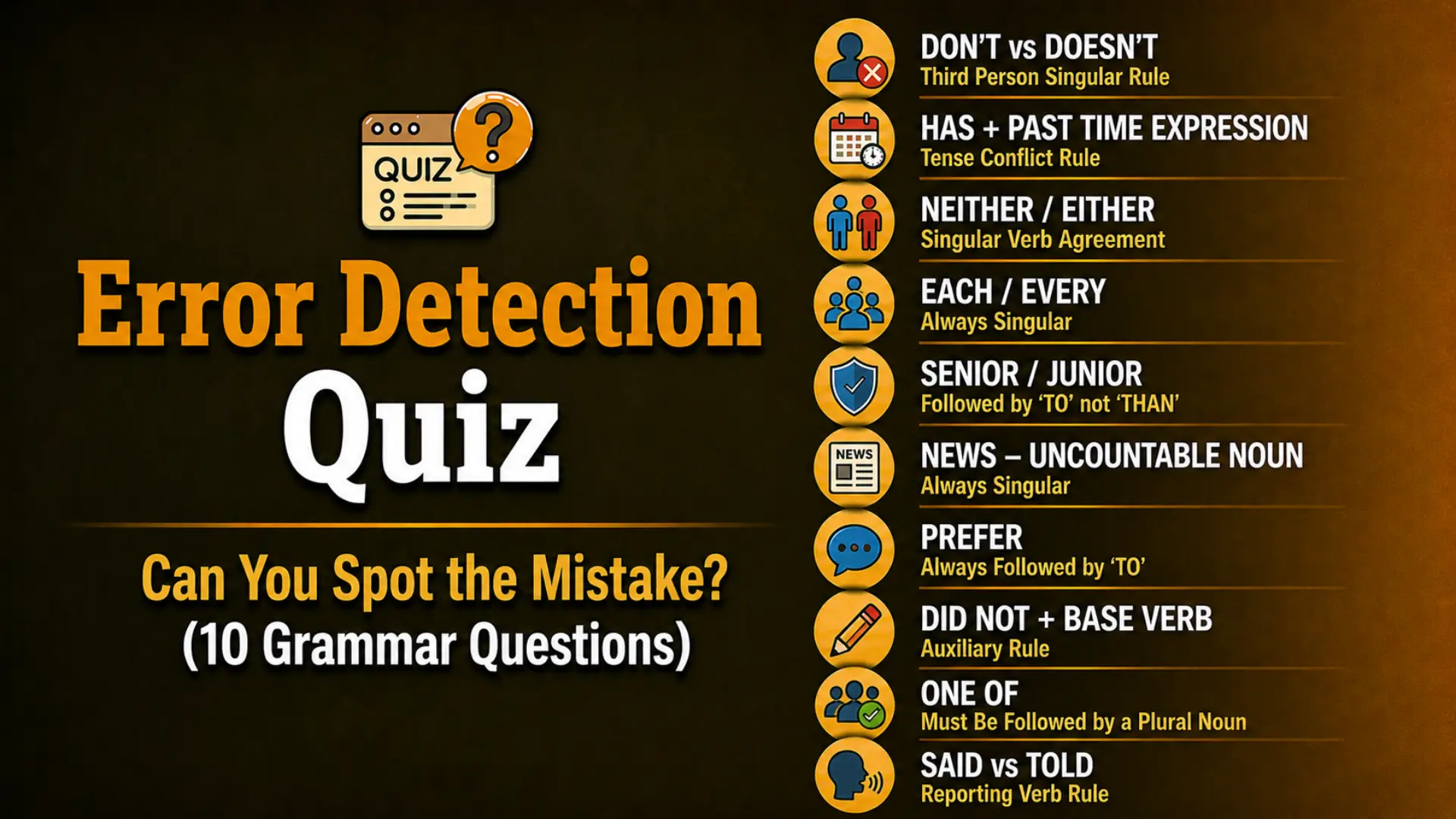
Do you think your English grammar is on point? Take this error detection quiz and find out! Many English learners — even advanced ones — make small grammar mistakes without even realizing it. A wrong verb form, a misplaced word, or a tricky subject-verb agreement can silently sneak into your sentences every single day.
This error detection quiz is designed to help you spot exactly those mistakes. You’ll get 10 carefully picked sentences, each hiding one grammar error. Your job? Find it! It’s simple, fun, and incredibly useful — whether you’re a student, a professional, or someone who just wants to sharpen their English skills.
If you’ve already tested yourself on our Common Grammar Errors Quiz, you know how surprising it can be to discover mistakes you never noticed before. This quiz takes it one step further — training your eye to catch errors fast.
Each question comes with a clear explanation so you don’t just pick the right answer — you actually understand why it’s wrong and how to fix it. That’s the real learning!
Also, if confusing words trip you up, don’t miss our Confusing Words Quiz — it’s a great companion to this one.
So, are you ready to put your grammar skills to the test? Scroll down, take the quiz, and let’s see how sharp your eyes really are!
📚 Error Detection Quiz: Complete Study Guide
Master these 10 essential grammar rules tested in this error detection quiz. Each concept includes the rule, real examples, and quick memory tricks to help you spot mistakes instantly — in tests, writing, and everyday English.
DON'T vs DOESN'T – Third Person Singular Rule
In negative sentences, the auxiliary verb must agree with the subject. For third person singular subjects (he, she, it), always use 'doesn't'. 'Don't' is used only with I, you, we, and they.
Formula: He / She / It + doesn't + base verb
✓ He doesn't know how to swim.
✓ She doesn't like coffee.
✗ He don't know how to swim. (wrong auxiliary for he)
✗ She don't like coffee. (don't cannot be used with she)
Whenever you see he, she, or it in a negative sentence, always use 'doesn't'. A simple check: swap the subject with 'he' — if it fits, use 'doesn't'. Common mistake: treating 'don't' as universal for all subjects.
HAS + PAST TIME EXPRESSION – Tense Conflict Rule
Present Perfect (has/have + past participle) cannot be used with specific past time expressions like yesterday, last week, last year, ago, or in 2020. When a specific past time is mentioned, use Simple Past tense instead.
Formula: Specific past time + Simple Past (NOT Present Perfect)
✓ She completed her work yesterday.
✓ He finished the project last week.
✗ She has completed her work yesterday. (has cannot pair with yesterday)
✗ He has finished the project last week. (last week demands Simple Past)
Think of Present Perfect as a tense with NO fixed time stamp. The moment you add yesterday, last night, or two days ago, you're fixing the action in time — and that calls for Simple Past. Spot the time word first, then choose your tense!
NEITHER / EITHER – Singular Verb Agreement
'Neither' and 'Either' are singular indefinite pronouns. Even though they refer to two people or things, they always take a singular verb. This is one of the most commonly tested grammar rules in error detection.
Formula: Neither / Either + of the + plural noun + singular verb (is/has/does/was)
✓ Neither of the boys has done their homework.
✓ Either of the girls is ready to perform.
✗ Neither of the boys have done their homework. (have is plural — incorrect)
✗ Either of the girls are ready. (are is plural — incorrect)
Don't be fooled by the plural noun that follows 'of the'. The verb must agree with Neither/Either, not with the noun. Rule of thumb: Neither/Either = One at a time = Singular verb always.
EACH / EVERY – Always Singular
'Each' and 'Every' are singular distributive pronouns. They refer to individual members of a group one at a time, so they always take a singular verb — regardless of the noun or pronoun that follows.
Formula: Each / Every + of the + plural noun + singular verb (is/was/has)
✓ Each of the players is ready.
✓ Every student has submitted the assignment.
✗ Each of the players are ready. (are is plural — wrong)
✗ Every student have submitted. (have is plural — wrong)
Each, Every, Either, Neither — all four are singular. Whenever you spot one of these words as the subject, immediately use a singular verb: is, was, has, does. No exceptions!
SENIOR / JUNIOR – Followed by 'TO' not 'THAN'
Adjectives ending in '-ior' (senior, junior, superior, inferior, prior) are Latin comparatives. They already carry the meaning of comparison within them, so they must be followed by 'to' — never by 'than'.
Formula: Senior / Junior / Superior / Inferior / Prior + to (NOT than)
✓ He is senior to me.
✓ This product is superior to the earlier version.
✗ He is senior than me. (than cannot follow senior)
✗ This product is superior than the earlier version. (than is incorrect here)
All Latin-origin '-ior' adjectives use 'to'. Easy way to remember: S.J.S.I.P — Senior, Junior, Superior, Inferior, Prior — all take 'to'. If you see 'than' after any of these words, it's always an error!
NEWS – Uncountable Singular Noun
'News' looks like a plural word because it ends in 's', but it is actually an uncountable singular noun. It always takes a singular verb. The same rule applies to other words like information, furniture, luggage, advice, and equipment.
Formula: News / Information / Furniture / Luggage + singular verb (is/was/has)
✓ The news is not good.
✓ The information provided was accurate.
✗ The news are not good. (are is plural — news is always singular)
✗ The informations are incorrect. (no plural form for information)
Words that look plural but are singular — News, Mathematics, Physics, Economics, Athletics. All of these take a singular verb. A helpful check: Can you count it? Can you say 'one news' or 'two news'? No! So it's always singular.
PREFER – Always Followed by 'TO' not 'THAN'
The verb 'prefer' expresses comparison but is always followed by 'to', not 'than'. This is a fixed grammatical pattern in English that must be memorized.
Formula: Prefer + noun/gerund + to + noun/gerund
✓ I prefer coffee to tea.
✓ She prefers walking to driving.
✗ I prefer coffee than tea. (than is incorrect after prefer)
✗ She prefers walking than driving. (than cannot follow prefer)
'Rather than' is different from 'prefer to'. You can say 'I would rather have coffee than tea' (rather + than ✓) but 'I prefer coffee to tea' (prefer + to ✓). The two structures are not interchangeable — mix them up and it becomes a grammar error!
DID NOT + BASE VERB – Auxiliary Rule
When using 'did' as an auxiliary verb in negative or question sentences, the main verb must always be in its base form (infinitive without 'to'). 'Did' already carries the past tense — so the main verb should NOT be in past tense again.
Formula: Did + not + base verb (NOT past tense form)
✓ She did not write the letter.
✓ He did not go to school yesterday.
✗ She did not wrote the letter. (wrote is past tense — cannot follow did not)
✗ He did not went to school. (went is past tense — incorrect with did)
In any sentence with did / does / will / can / should — the main verb is ALWAYS in base form. Did already signals past tense, so using a past tense verb again is double-marking — a classic error in error detection tests!
ONE OF – Must Be Followed by a Plural Noun
'One of' is always followed by a plural noun. Even though 'one' is singular, the phrase 'one of' refers to a single item from a group — so the noun representing the group must be plural. The verb, however, remains singular.
Formula: One of + plural noun + singular verb
✓ One of my friends lives abroad.
✓ One of the students was absent.
✗ One of my friend lives abroad. (friend must be plural — friends)
✗ One of the student was absent. (student must be plural — students)
After 'One of' → (1) noun must be PLURAL, (2) verb must be SINGULAR. Both parts are commonly tested together. Example: 'One of my friends [plural noun] is [singular verb] a doctor.' Get both right and you've nailed this rule!
SAID vs TOLD – Reporting Verb Rule
'Said' and 'Told' are both reporting verbs but they follow different patterns. 'Said' does not need an object — it is followed directly by 'that' or the reported speech. 'Told' must always have a personal object (me, him, her, us, them) before 'that'.
Formula: Said + (that) + clause | Told + person + (that) + clause
✓ He said that he was tired.
✓ He told me that he was tired.
✗ He told that he was tired. (told must have an object — told me/him/her)
✗ He said me that he was tired. (said cannot take a personal object)
TOLD needs a TARGET — you always tell SOMEONE. SAID needs nothing — you just say it. Quick test: Can you insert 'me' or 'him' after the verb? If yes, use 'told'. If no, use 'said'. This rule catches errors in almost every grammar test!
⚡ Continue Learning
Grammar Quizzes