
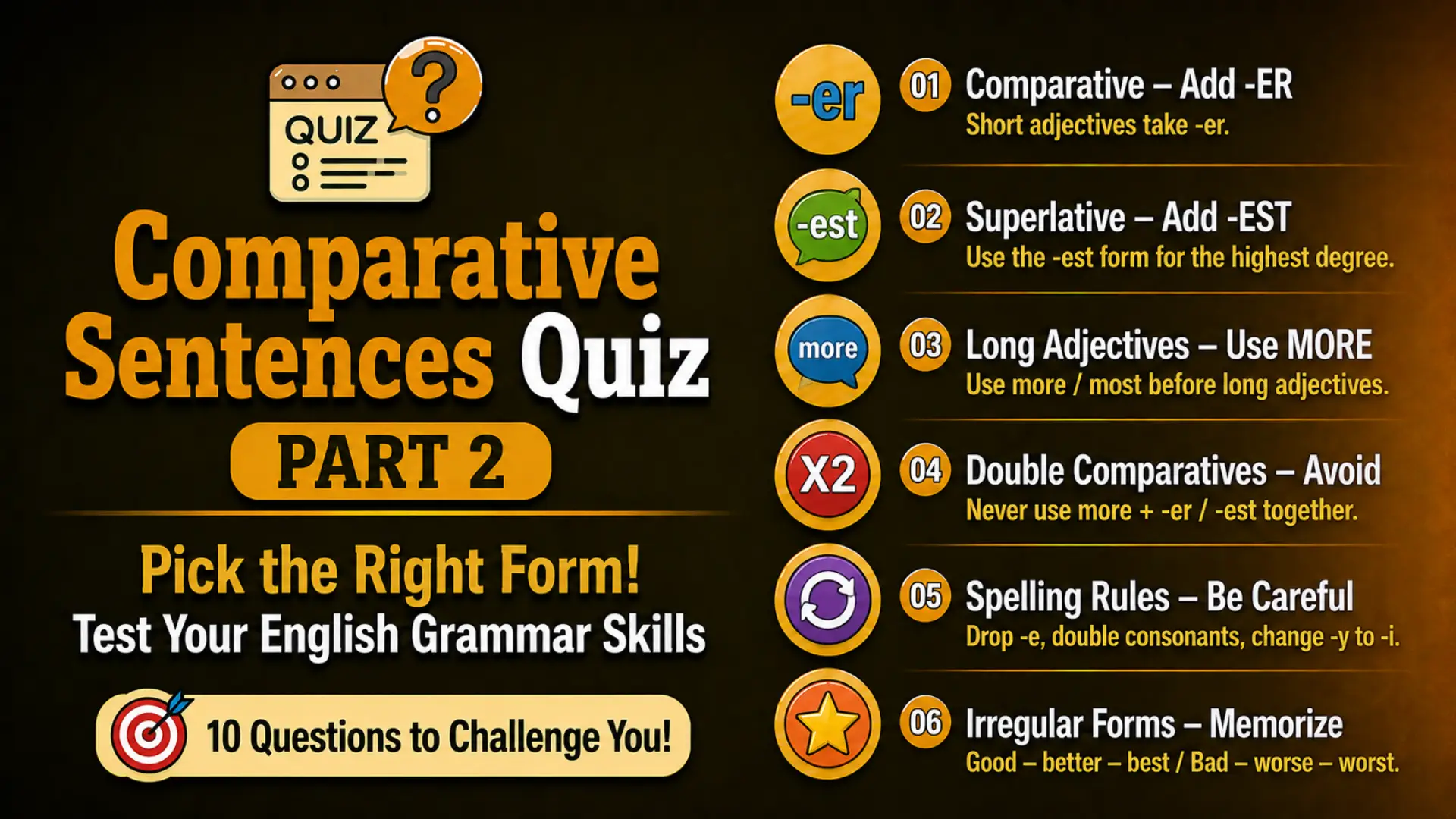
Think you’ve mastered comparative sentences in English? It’s time to find out! This comparative sentences quiz is Part 2 of our popular series. It’s fun, fast, and perfect for all levels.
Haven’t tried Part 1 yet? Start with our Comparative Sentences Quiz – Part 1 to warm up. Then come back here for a bigger challenge!
Here’s the truth — most people think they know comparatives. But real sentences can be tricky. When do you use “more”? When do you add “-er” or “-est”? Even confident speakers get confused. This quiz will show you exactly where you stand.
Comparatives and superlatives pop up every single day. You use them when you say “she is taller than me” or “this is the best coffee I’ve ever had.” Getting them wrong can make your English sound unnatural. Getting them right makes a huge difference. That’s why practising with real quiz questions is so important.
The best part? You don’t just get a score. Every question has a clear explanation. You’ll also see the grammar pattern behind each answer. So you actually learn as you go. That’s the ClipYourEnglish way!
This part covers 10 carefully picked questions. They test real-world sentence patterns. You’ll see irregular forms, tricky adjectives, and common mistakes. It’s the perfect next step after Part 1.
Once you finish, keep the momentum going! Try our Adverbs Quiz next. Adverbs are another area where small mistakes make a big difference in your English.
Ready? Scroll down and start the comparative sentences quiz now. No sign-up needed. No pressure. Just great grammar practice — one question at a time!
📚 Comparative Sentences: Complete Study Guide
Master the key rules behind comparative and superlative adjectives. Each section covers the grammar formula, common mistakes, and real examples to help you ace any comparative sentences quiz with confidence.
COMPARATIVE ADJECTIVES – The -ER Rule
Use the comparative form to compare two people, things, or situations. For most short adjectives (one or two syllables), simply add -er to the adjective.
Formula: Adjective + -er + than
Common Examples: tall → taller / wide → wider / young → younger / long → longer / strong → stronger
✓ This road is than that one.
✓ She is younger than her sister.
✗ This road is more wide than that one. (incorrect — short adjectives don't use 'more')
✗ She is more young than her sister. (incorrect — add -er instead)
Never use 'more' with short adjectives that already take -er. Saying 'more taller' or 'more wider' is a double comparative — one of the most common mistakes in English! Just pick one: either 'more' OR '-er', never both together.
SUPERLATIVE ADJECTIVES – The -EST Rule
Use the superlative form to compare one person or thing against a whole group — it sits at the top (or bottom) of the comparison. For most short adjectives, add -est and use the before it.
Formula: the + Adjective + -est
Common Examples: tall → tallest / long → longest / strong → strongest / young → youngest
✓ This is the building here.
✓ This is the longest road in the city.
✗ This is the most tall building here. (incorrect — short adjectives use -est)
✗ This is the taller building here. (incorrect — taller compares two, not a group)
Always use 'the' before a superlative adjective. You wouldn't say 'she is tallest girl' — it must be 'she is the tallest girl'. Missing 'the' is one of the top grammar mistakes learners make with superlatives!
SPELLING RULES – When the Spelling Changes
Adding -er or -est isn't always straightforward. Some adjectives follow special spelling rules before the ending is added.
Three Key Spelling Rules:
1️⃣ Adjectives ending in -e: Drop the -e, then add -er / -est
→ wide → wider → widest
2️⃣ Adjectives ending in consonant + vowel + consonant: Double the final consonant, then add -er / -est
→ big → bigger → biggest
3️⃣ Adjectives ending in -y: Change -y to -i, then add -er / -est
→ happy → happier → happiest / heavy → heavier → heaviest
✓ My bag is than yours. (heavy → heavier ✔)
✓ She is happier than before. (happy → happier ✔)
✗ My bag is more heavy than yours. (incorrect — follow the -y rule)
✗ This road is more wider than that one. (incorrect — double comparative error)
For -y adjectives, just remember: Y says goodbye, I takes over! So happy becomes happier, easy becomes easier, and heavy becomes heavier. Once you remember this rule, a whole group of adjectives becomes easy to handle!
IRREGULAR FORMS – Good, Better, Best
Some adjectives don't follow the normal -er / -est pattern at all. These are called irregular comparatives and superlatives and they must be memorised — there is no shortcut!
The Most Important Irregular Forms:
good → better → best
bad → worse → worst
far → farther / further → farthest / furthest
little → less → least
✓ He is than me in chess. (good → better ✔)
✓ This is the best solution. (good → best ✔)
✗ He is more good than me in chess. (incorrect — 'good' is irregular)
✗ This is the goodest solution. (incorrect — there is no such word!)
Irregular forms cannot be worked out from rules. 'Gooder', 'goodest', and 'more good' are never correct. The good news? There are only a handful of common irregular adjectives in English. Learn them once and you'll never make this mistake again!
DOUBLE COMPARATIVES – A Very Common Mistake
In English, you must choose one way to form the comparative or superlative — either add -er / -est OR use more / most. Never use both at the same time. Using both together is called a double comparative and it is always incorrect.
When to use MORE / MOST: Long adjectives (3 or more syllables) use 'more' and 'most' instead of -er / -est.
Examples: beautiful → more beautiful / most beautiful
interesting → more interesting / most interesting
✓ This task is than the last one. (short adjective → use -er ✔)
✓ This is more interesting than I expected. (long adjective → use 'more' ✔)
✗ This task is more easier than the last one. (double comparative — never correct!)
✗ This is more wider than that. (double comparative — never correct!)
Short adjective (1–2 syllables) = -er / -est. Long adjective (3+ syllables) = more / most. When in doubt, count the syllables! 'Easy' has 2 syllables → easier. 'Beautiful' has 3 syllables → more beautiful. This one rule will save you from a very common error!
⚡ Continue Learning
Grammar Quizzes