
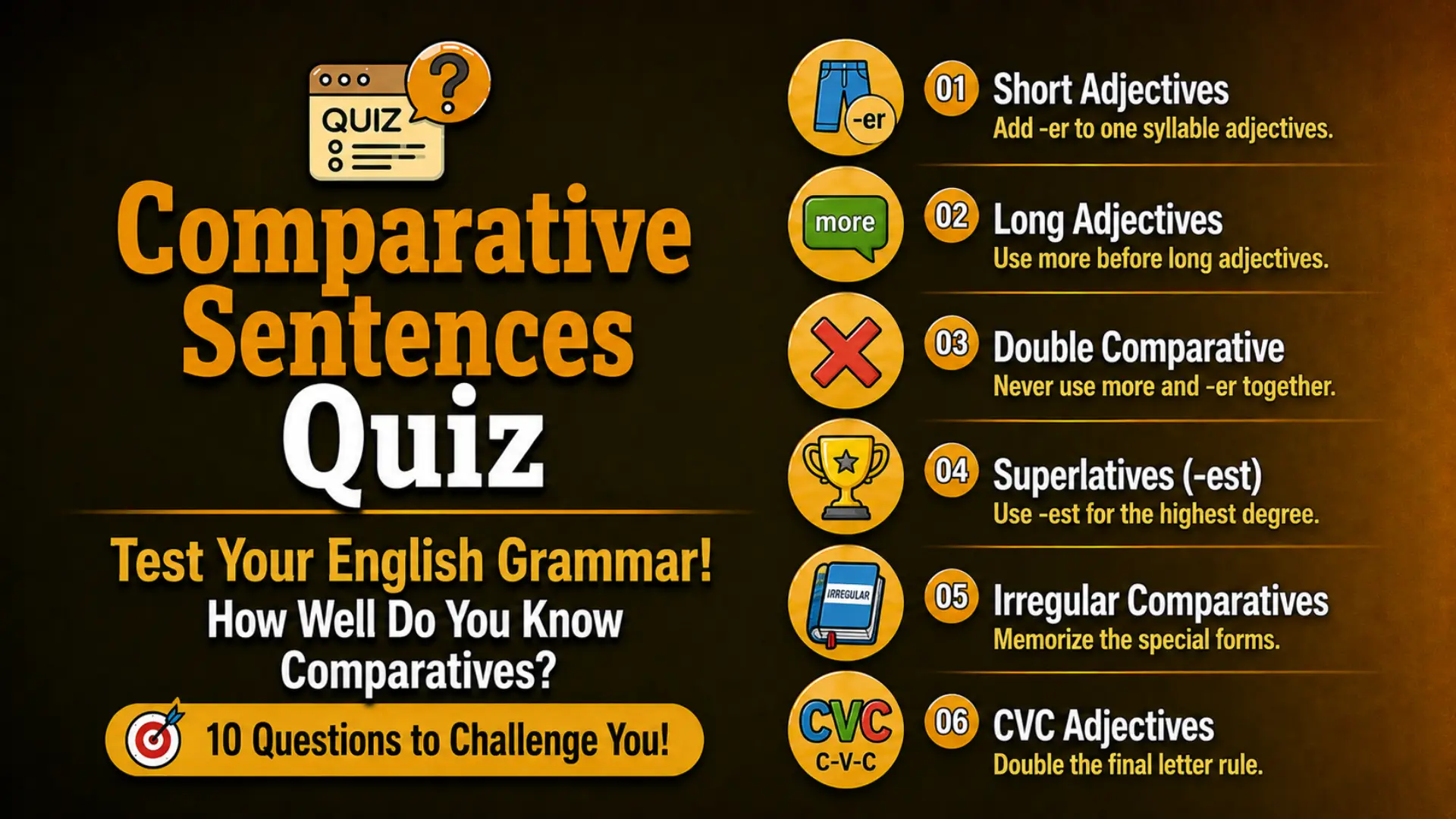
Have you ever struggled with comparative sentences in English? You’re not alone! Many learners make simple mistakes like saying “more bigger” or “interestinger” without even realising it. This comparative sentences quiz is designed to help you spot those mistakes, learn the correct rules, and practise in a fun and simple way.
Comparatives are used every single day in real English — at work, in conversations, in emails, and even in casual texting. Sentences like “This phone is better than that one” or “She is smarter than her classmate” are everywhere. But choosing the right form — whether to use -er, more, or an irregular form — is where most learners get confused.
That’s exactly why we created this quiz. Whether you’re a beginner just starting out or an intermediate learner looking to sharpen your grammar, this comparative sentences quiz will challenge you in the right way. It features 10 carefully crafted fill-in-the-blank questions, each with 3 options, a clear correct answer, and a simple explanation so you truly understand the rule — not just memorise the answer.
Before you dive in, if you haven’t already, go check out our Common Grammar Errors Quiz — it’s a great way to catch the mistakes most learners don’t even know they’re making. And if you want to level up further, our Adverbs Quiz is another brilliant practice session to add to your learning routine.
After the quiz, don’t skip the Study Guide below — it breaks down every grammar rule tested in the quiz with real examples and tips you can actually use.
Ready? Let’s find out how well you really know your comparative sentences!
📚 Comparative Sentences: Complete Study Guide
Master the rules behind comparative sentences and never second-guess your grammar again. Each rule includes a clear explanation, real examples, and common mistakes to avoid — so you can use comparatives confidently in speaking and writing.
SHORT ADJECTIVES – Add -ER
For short adjectives (one syllable), add -er to make the comparative form. Always follow it with 'than' when comparing two things.
Common Examples: cold → colder | tall → taller | narrow → narrower | fast → faster | old → older
✓ Today is than yesterday.
✓ He is taller than his brother.
✓ This road is narrower than the highway.
✗ Today is more cold than yesterday. (incorrect — short adjectives don't use 'more')
✗ He is more tall than his brother. (incorrect — never combine 'more' with -er)
Never use 'more' with short adjectives. Saying 'more cold' or 'more tall' is a very common learner mistake. If the adjective is one syllable — always go with -er. Quick test: Can you say it in one beat? Then use -er!
LONG ADJECTIVES – Use MORE
For longer adjectives (two or more syllables), use 'more' before the adjective to form the comparative. Never add -er to long adjectives.
Common Examples: interesting → more interesting | beautiful → more beautiful | expensive → more expensive | comfortable → more comfortable
✓ This book is than that one.
✓ This sofa is more comfortable than the old one.
✗ This book is interestinger than that one. (incorrect — never add -er to long adjectives)
✗ This book is interesting than that one. (incorrect — missing comparative form entirely)
A simple way to remember — if the adjective feels 'long' or takes more than one beat to say, use 'more'. Interesting (4 beats) → more interesting. Beautiful (3 beats) → more beautiful. Never say 'interestinger' — it doesn't exist in English!
DOUBLE COMPARATIVE – A Common Mistake
Never use 'more' and '-er' together. This is called a double comparative and it is always grammatically incorrect in English.
Common Mistakes: more narrower ✗ | more taller ✗ | more bigger ✗ | more colder ✗
✓ This road is than the highway.
✓ My house is bigger than yours.
✗ This road is more narrower than the highway. (double comparative — always wrong)
✗ My house is more bigger than yours. (double comparative — always wrong)
Think of it like paying twice for one thing — you only need one comparative marker, not two! Either use -er OR use more — never both together. If you see 'more + -er' anywhere, it is always an error.
SUPERLATIVES – The -EST Form
Use the superlative form when comparing one thing against a whole group (three or more). For short adjectives, add -est. Always use 'the' before the superlative.
Common Examples: smart → smartest | happy → happiest | fast → fastest | old → oldest
✓ She is the student in the class.
✓ It was the happiest day of my life.
✓ This is the funniest movie I've ever seen.
✗ She is the smarter student in the class. (comparative, not superlative — wrong context)
✗ She is the more smart student in the class. (incorrect superlative form)
Watch out for adjectives ending in -y! Change the 'y' to 'i' before adding -est. Happy → happiest, funny → funniest, lucky → luckiest. Also remember — superlatives always need 'the' in front of them!
IRREGULAR COMPARATIVES – Know Them by Heart
Some adjectives do not follow the regular -er / -est or more / most pattern. These are called irregular comparatives and must be memorised individually.
Must-Know Irregular Forms:
good → better → best
bad → worse → worst
far → further / farther → furthest / farthest
✓ She is at math than me.
✓ That was the worst mistake.
✗ She is more good at math than me. (incorrect — 'good' is irregular, never use 'more good')
✗ That was the baddest mistake. (incorrect — 'badder/baddest' do not exist in standard English)
For good → better → best, think: 'Good things get better and then reach their best!' For bad → worse → worst, think: 'Bad things get worse until they hit their worst!' These two pairs are the most tested irregular comparatives in English exams — memorise them!
CVC ADJECTIVES – Double the Final Letter
For short adjectives that end in Consonant – Vowel – Consonant (CVC), double the final consonant before adding -er or -est.
Common Examples: big → bigger | hot → hotter | thin → thinner | fat → fatter | sad → sadder
✓ My house is than yours.
✓ It is hotter today than last week.
✗ My house is biger than yours. (incorrect — must double the 'g')
✗ My house is more big than yours. (incorrect — 'big' is a short adjective, use -er not 'more')
Before adding -er, look at the last 3 letters of the adjective. Is it Consonant–Vowel–Consonant? b-i-g ✓ | h-o-t ✓ | t-h-i-n ✓ — if yes, double the last letter! This rule prevents awkward spellings and is one of the most commonly tested spelling rules in English grammar.
⚡ Continue Learning
Grammar Quizzes