
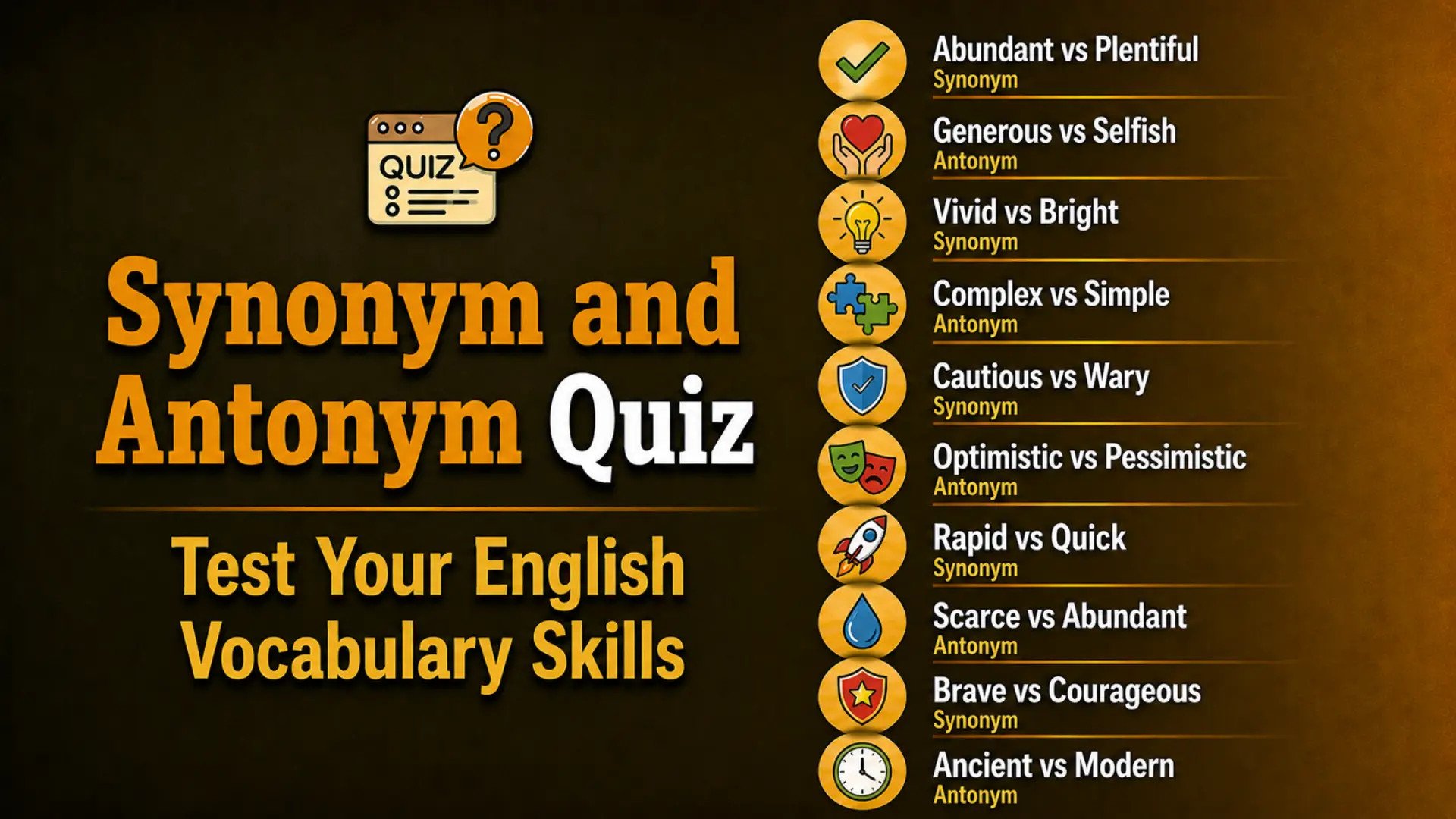
Do you know the difference between a synonym and an antonym? Whether you’re a student, a working professional, or just someone who loves learning English — this synonym and antonym quiz is the perfect way to test how strong your vocabulary really is!
We all use words every day, but do we truly understand them? Knowing synonyms (words that mean the same) and antonyms (words that mean the opposite) can completely transform the way you speak and write in English. It makes your communication sharper, smarter, and more confident.
If you’ve already tried our Confusing Words Quiz – Can You Choose the Right Word? or challenged yourself with Confusing Words Quiz Part 2, then this synonym and antonym quiz is your next step to level up your vocabulary game!
This quiz has 10 carefully picked questions with 3 options each. Every question comes with a clear explanation so you don’t just pick an answer — you actually learn from it. No timer, no pressure — just you and your words!
So, are you ready to find out how well you know your synonyms and antonyms? Scroll down, take the quiz, and let’s see your score!
📚 Synonym and Antonym Quiz: Complete Study Guide
Master these 10 essential synonym and antonym pairs and take your English vocabulary to the next level. Each word includes meaning, real examples, and smart tips to help you choose the right word every time.
ABUNDANT – Plentiful & Plenty
'Abundant' means existing in large quantities — more than enough. Its synonym is 'Plentiful', which also describes something available in great amounts.
Common Collocations: abundant + resources / supply / energy / rainfall / opportunities
✓ The region has abundant natural resources.
✓ There is a plentiful supply of fresh water here.
✗ The region has scarce natural resources. (scarce = very little — opposite meaning)
✗ The region has rare natural resources. (rare = uncommon — different nuance)
Abundant → Plentiful → Ample → Copious. These are all synonyms that mean 'more than enough'. In formal writing, 'abundant' and 'plentiful' are the most commonly used pair. Avoid using 'a lot of' in academic writing — use 'abundant' instead!
GENEROUS – Selfish (Antonym Pair)
'Generous' means willingly giving time, money, or help to others. Its antonym is 'Selfish' — someone who thinks only about themselves and does not share with others.
Common Collocations: generous + donation / offer / spirit / person / act | selfish + behavior / attitude / motive / desire
✓ She was generous enough to donate all her savings to charity.
✓ His selfish behavior upset the entire team.
✗ She was selfish enough to donate her savings. (selfish and donate contradict each other)
✗ His generous behavior upset the team. (generous behavior rarely upsets people)
Generous ↔ Selfish is one of the most common antonym pairs in English. Related words: Generous → Charitable → Giving. Selfish → Self-centered → Greedy. Upgrading your vocabulary with these pairs will help you describe people and personalities more precisely.
VIVID – Bright & Striking
'Vivid' means producing powerful, clear, and strong images or impressions. Its synonym is 'Bright', which shares the quality of being strong, striking, and full of life.
Common Collocations: vivid + imagination / description / memory / colors / dream / imagery
✓ She has a vivid imagination that brings her stories to life.
✓ The artist used bright, vivid colors in the painting.
✗ She has a dull imagination. (dull = lacking energy or brightness — antonym)
✗ The painting had faint colors. (faint = weak and unclear — antonym)
Use 'vivid' to make your descriptions more powerful. Instead of saying 'I have a clear memory', say 'I have a vivid memory'. Instead of 'bright colors', try 'vivid colors'. This instantly makes your writing more expressive and C1–C2 level!
COMPLEX – Simple (Antonym Pair)
'Complex' means made of many connected parts and difficult to understand. Its antonym is 'Simple' — something that is easy to understand, with few parts or complications.
Common Collocations: complex + problem / system / process / issue / structure | simple + solution / task / method / approach / answer
✓ The engineer solved a very complex problem in just one hour.
✓ Let me give you a simple explanation instead.
✗ The engineer solved a simple problem. (simple and solving in one hour wouldn't be impressive)
✗ Let me give you a complex explanation. (complex explanations are harder to understand)
Complex vs Complicated vs Intricate. Complex = many connected parts. Complicated = difficult to deal with. Intricate = detailed and elaborate. Simple is the true antonym of all three, but most directly pairs with 'complex' in academic and professional English.
CAUTIOUS – Wary & Careful
'Cautious' means being careful to avoid potential problems or dangers. Its synonym is 'Wary', which means feeling alert and suspicious about possible risks.
Common Collocations: cautious + approach / optimism / driver / investor / response | wary + of strangers / of risks / of change / of promises
✓ You should be cautious when signing any financial agreement.
✓ She was wary of making the same mistake twice.
✗ You should be reckless when signing financial agreements. (reckless = taking dangerous risks — antonym)
✗ She was careless about making the same mistake. (careless = not paying attention — antonym)
Cautious = careful in your actions. Wary = careful in your trust or judgment. Both are synonyms but with a slight difference in use. 'Cautious optimism' is a very popular phrase in business English — it means being hopeful but not overconfident!
OPTIMISTIC – Pessimistic (Antonym Pair)
'Optimistic' means expecting the best possible outcome in any situation. Its antonym is 'Pessimistic' — expecting the worst or believing things will go wrong.
Common Collocations: optimistic + outlook / view / forecast / attitude | pessimistic + view / attitude / prediction / tone
✓ Despite the challenges, she remained optimistic about the future.
✓ A pessimistic attitude can reduce your chances of success.
✗ She remained pessimistic about the future despite the opportunities. (pessimistic contradicts positivity)
✗ An optimistic attitude reduces your chances of success. (optimism generally helps, not hurts)
Optimistic → Optimism → Optimist. Pessimistic → Pessimism → Pessimist. These are very common in academic essays and discussions about society, economy, and the future. A great C1–C2 phrase: 'There is cautious optimism about the country's economic recovery.'
RAPID – Quick & Fast
'Rapid' means happening in a very short time or moving with great speed. Its synonym is 'Quick', which also describes speed but is used more in everyday contexts.
Common Collocations: rapid + growth / change / development / decline / response | quick + decision / fix / reply / glance / learner
✓ The country experienced rapid economic growth over the decade.
✓ She is a quick learner who adapts to new environments easily.
✗ The country experienced slow economic growth. (slow = opposite of rapid)
✗ She is a sluggish learner. (sluggish = moving slowly — antonym)
'Rapid' is more formal than 'quick'. Use 'rapid' in academic writing, reports, and professional contexts. Use 'quick' in everyday conversations. Example: 'rapid urbanization' (formal) vs 'a quick chat' (informal). Knowing register helps you sound natural in every situation!
SCARCE – Abundant (Antonym Pair)
'Scarce' means available only in small quantities — not enough for the demand. Its antonym is 'Abundant', which means available in large, more than sufficient quantities.
Common Collocations: scarce + resources / water / food / jobs / supply | abundant + resources / rainfall / opportunities / energy
✓ Clean drinking water is scarce in many parts of the world.
✓ The Amazon rainforest has abundant biodiversity.
✗ Clean drinking water is abundant in drought-affected areas. (abundant contradicts scarcity)
✗ The rainforest has scarce biodiversity. (rainforests are known for richness, not scarcity)
Scarce ↔ Abundant is a very important antonym pair in economics, environmental studies, and geography. A useful phrase: 'Scarce resources must be managed carefully.' Knowing this pair helps you discuss global issues like water scarcity and food security confidently.
BRAVE – Courageous & Bold
'Brave' means ready to face danger, pain, or difficulty without showing fear. Its synonym is 'Courageous', which carries a slightly stronger and more formal meaning — showing great courage especially in difficult situations.
Common Collocations: brave + soldier / decision / face / act / heart | courageous + leader / action / stand / choice / effort
✓ The brave firefighter ran into the burning building.
✓ It takes a courageous leader to make unpopular but necessary decisions.
✗ The cowardly firefighter ran into the burning building. (cowardly = lacking courage — antonym)
✗ A timid leader makes strong decisions. (timid = shy and fearful — antonym)
Bold → Brave → Courageous → Valiant → Heroic. These words increase in formality and intensity. 'Brave' is perfect for everyday use. 'Courageous' is ideal for formal writing and speeches. 'Valiant' and 'heroic' are used for truly exceptional acts of bravery.
ANCIENT – Modern (Antonym Pair)
'Ancient' means belonging to the very distant past — thousands of years ago. Its antonym is 'Modern', which refers to the present time or recent times, often associated with new technology and ideas.
Common Collocations: ancient + civilization / history / ruins / traditions / language | modern + technology / society / architecture / lifestyle / era
✓ The archaeologist discovered an ancient civilization buried underground.
✓ Modern technology has changed the way we communicate forever.
✗ The archaeologist discovered a modern civilization buried underground. (modern civilizations are not buried ruins)
✗ Ancient technology has changed the way we communicate. (ancient technology refers to the past, not current change)
Ancient → Historic → Traditional → Contemporary → Modern. This is a useful timeline of adjectives describing time periods. In academic writing, knowing the difference between 'historic' (important in history) and 'ancient' (from long ago) can make your writing much more precise and impressive.
⚡ Continue Learning
Quiz- Phrasal Verbs Quiz for Beginners – How Many Can You Get Right?
- Error Detection Quiz: Can You Spot the Mistake? (10 Grammar Questions)
- Intermediate English Prepositions Quiz – How Well Do You Know Your Grammar?
- Confusing Words Quiz: Can You Choose the Right Word Every Time?
- Advanced English Vocabulary Quiz: C1–C2 Level Words You Must Know
