
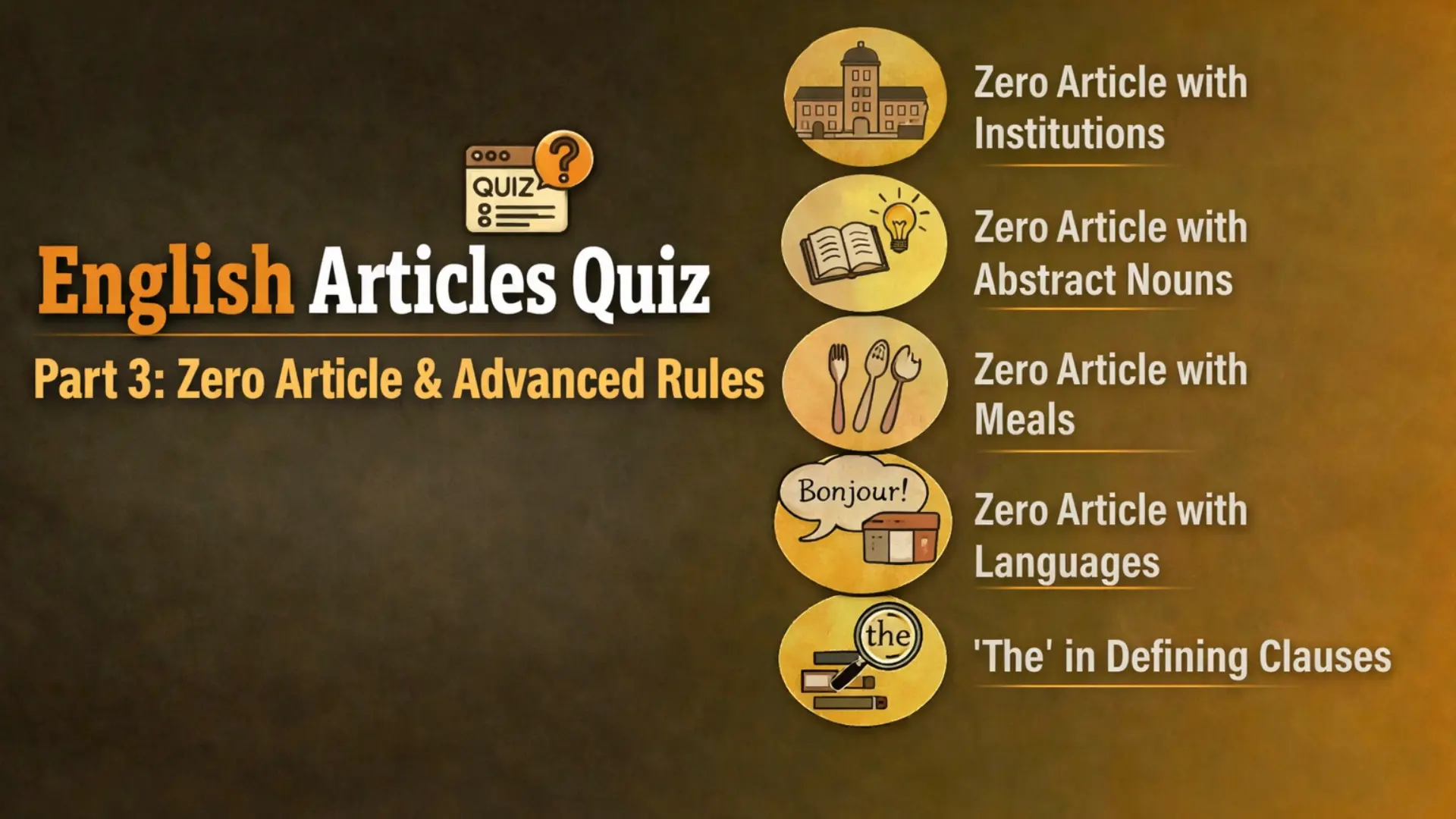
You made it to Part 3 — and things are about to get interesting!
If you’ve already tackled English Articles Quiz Part 1 (a/an rules) and Part 2 (the definite article), you know how sneaky articles can be. But nothing trips up English learners quite like the zero article — knowing when to use absolutely nothing at all.
She goes to school vs. She goes to the school. Same words. Totally different meaning. That one missing “the” changes everything.
In this final part of our series, we’re diving into the most advanced and confusing article rules — the ones that even fluent speakers sometimes get wrong. When do meals, languages, and abstract concepts drop the article entirely? When does context suddenly bring “the” back into the picture? These are the questions that separate good English from great English.
This quiz features 10 carefully crafted questions with detailed explanations for every answer, so you don’t just guess — you get it.
Think you’re ready? Let’s find out how well you truly know your articles. Take the quiz below! 👇
📚 Complete Study Guide
Master Articles A, An & The — One Rule at a Time
Zero Article with Institutions (School, Hospital, Church)
When we visit an institution for its primary purpose, we use no article. The focus is on the activity or function, not the physical building.
Formula: go to + [institution] = purpose/function (zero article)
Formula: go to + the + [institution] = specific building (with article)
✓ She goes to school every day. (she is a student)
✓ He is in hospital. (he is a patient)
✓ They go to church on Sundays. (they worship)
✗ She goes to the school every day. (this means a specific school building, not that she is a student)
Ask yourself — is the person there for the institution's core purpose? If yes, drop the article. If you're just visiting the building, keep "the".
Visiting vs. Being IN an Institution
The same institution can take zero article OR "the" depending on your role. Zero article = you are there as a participant (patient, student, prisoner). "The" = you are there as an outsider or visitor.
Key Contrast: Role as participant → zero article | Role as visitor → "the"
✓ He is in hospital. (he is a patient)
✓ She went to the hospital to see her friend. (she is a visitor)
✓ The children are at school. (they are students)
✓ I went to the school to meet the principal. (I am a visitor)
Are you there because of your own role (student/patient)? → No article. Are you going to meet someone else? → Use "the".
Zero Article with Abstract Nouns
Abstract nouns used in a general, philosophical sense take no article. They represent concepts as a whole, not a specific instance.
Common Abstract Nouns: life, love, freedom, happiness, hope, death, nature, time
✓ Life is full of surprises. (life in general)
✓ Love is the most powerful force. (love as a concept)
✓ Freedom is worth fighting for. (freedom in general)
✗ The life is full of surprises. (incorrect — too general for "the")
If you can replace the noun with a universal idea that applies to everyone, it's general — drop the article. The moment a clause defines or limits it ("the life we live"), bring "the" back.
"The" with Nouns Made Specific by a Defining Clause
Even nouns that normally take no article (abstract nouns, meals, institutions) require "the" when followed by a defining relative clause or phrase that makes them specific and identifiable.
Formula: the + noun + [defining clause/phrase] = specific, identifiable noun
✓ The life we live today is very fast-paced. ("we live today" defines which life)
✓ The dinner we planned yesterday was wonderful. ("we planned yesterday" identifies the dinner)
✓ The school where she teaches is very old. ("where she teaches" identifies the school)
✗ Life we live today is fast-paced. (incorrect — the defining clause requires "the")
Watch for words like "we planned", "I had", "you mentioned", "where", "that", "which" after a noun — these defining phrases almost always signal that "the" is needed.
"The" with Musical Instruments
When talking about playing a musical instrument as a skill or activity, always use "the" before the instrument. This is a fixed convention in English.
Formula: play + the + instrument
✓ He plays the guitar very well.
✓ She is learning the piano.
✓ Mozart played the violin at age five.
✗ He plays guitar very well. (common in informal speech but incorrect in standard grammar)
Think of "the" as a crown you place on the instrument when someone masters it. Play THE piano, play THE violin — the instrument deserves the spotlight!
Zero Article with Languages
Languages never take an article when used alone as a noun or object. They are treated as proper nouns referring to the language as a whole system.
Pattern: speak/learn/study/understand + [language] = no article
✓ She is learning French.
✓ He speaks Japanese fluently.
✓ They are studying Arabic at university.
✗ She is learning the French. (incorrect)
"The French" refers to French people, not the language. "The English" means the English people. Context and the noun that follows will tell you which meaning is intended.
Zero Article with Meals
The names of meals (breakfast, lunch, dinner, brunch, supper) take no article in general usage. However, when the meal is modified by a defining phrase or adjective that makes it specific, "the" or "a" may be required.
Pattern: have/eat/make + [meal] = zero article (general) | the/a + meal + [defining phrase] = specific
✓ They had dinner at 8 pm. (general routine)
✓ We always eat breakfast together. (habitual action)
✓ The dinner we planned yesterday was amazing. (specific, defined meal)
✓ She cooked a wonderful dinner. ("a" used with adjective)
✗ They had the dinner at 8 pm. (incorrect — no defining phrase present)
Bare meal name = no article. Add a description or defining clause? Then "the" or "a" steps in. Ask yourself: do both the speaker and listener know exactly which meal? If yes, use "the".
Enjoyed this quiz? There’s more where that came from! 🎉 Subscribe to the ClipYourEnglish Newsletter and get fresh English tips every week — right in your inbox. And here’s the best part — every new subscriber gets our free PDF eBook “Idiom Toolbox” as a welcome gift, packed with everyday idioms, simple explanations, and quick exercises to practice what you learn!
⚡ Continue Learning
Grammar Quizzes