
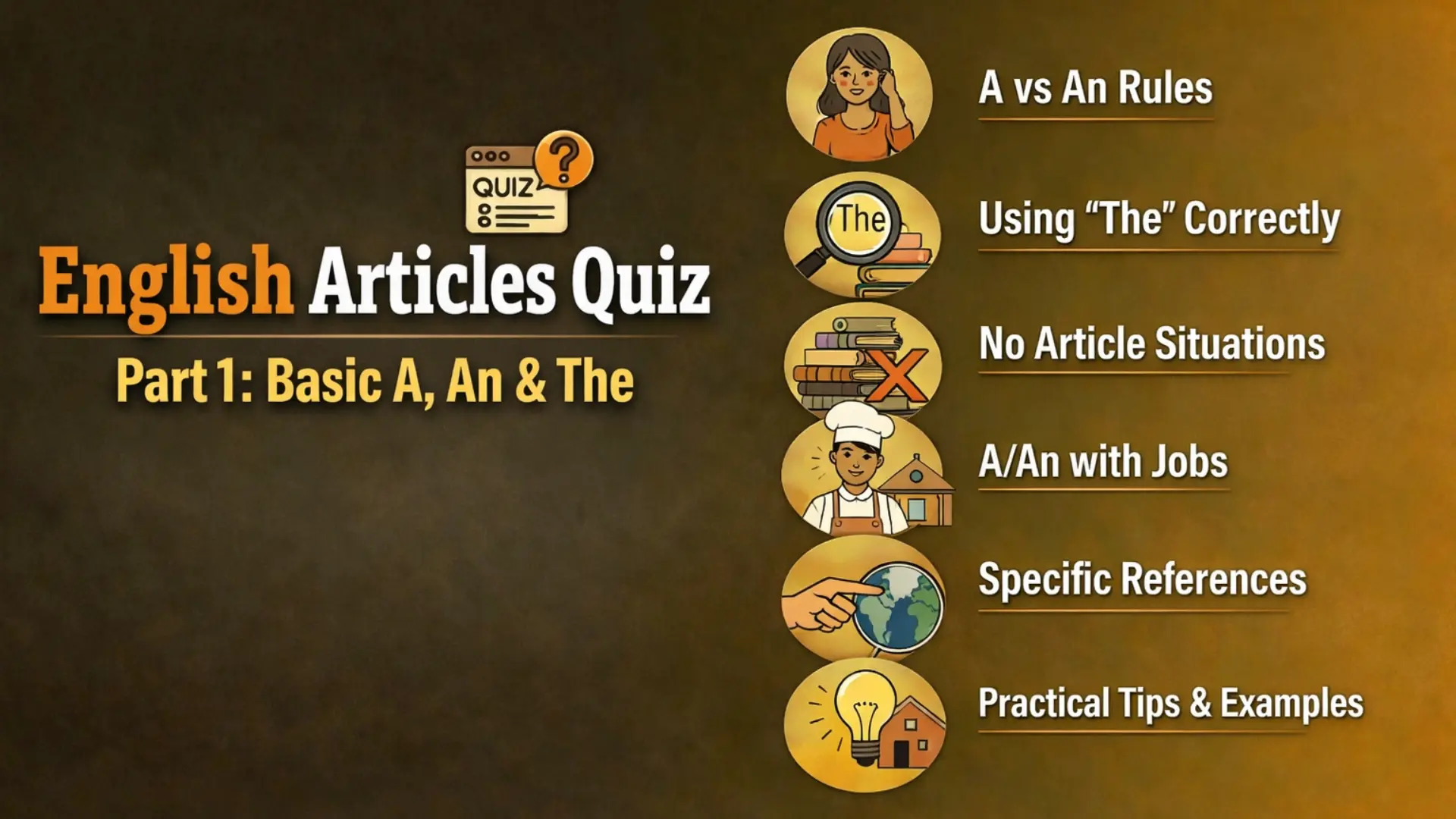
Struggling with articles in English? You’re not alone! Many learners find it confusing to choose between a, an, and the — and knowing when to use no article at all makes it even trickier. One small mistake can change the entire meaning of your sentence. That’s why we’ve created this English articles quiz to help you master these essential grammar rules.
This quiz features 10 real-world questions that test your knowledge of the most commonly confused articles. Each question comes with detailed explanations, examples, and practical tips so you don’t just find the right answer — you understand why it’s correct.
Whether you’re a beginner just learning the basics or an intermediate learner looking to sharpen your skills, this quiz is perfect for all levels. Ready to boost your grammar confidence? Let’s dive in and find out how well you know your articles!
📚 Complete Study Guide
Master Articles A, An & The — One Rule at a Time
A vs AN – It's About Sound, Not Spelling
Use 'a' before words that begin with a consonant sound and 'an' before words that begin with a vowel sound. It is the pronunciation that matters, not the first letter.
Formula: A + consonant sound | AN + vowel sound
✓ She is an honest woman (silent 'h' = vowel sound)
✓ He went to a university ('yoo' sound = consonant sound)
✓ She bought an orange (vowel sound 'o')
✗ She is a honest woman (incorrect)
Always say the word out loud. If it starts with a vowel sound (a, e, i, o, u), use 'an'. If it starts with a consonant sound, use 'a'. Example: a university, an umbrella.
THE – For Specific & Unique Things
Use 'the' when referring to something specific, already known to both the speaker and listener, or when something is one of a kind.
Use THE for: Unique things (the sun, the moon) | Directions (the east, the west) | Superlatives (the best, the tallest) | Named places (the Hilton, the Nile)
✓ The sun rises in the east
✓ He is the best player on the team
✓ We stayed at the Hilton Hotel
✗ A sun rises in east (incorrect)
Ask yourself – Is it unique? Is it already known? Is it the only one? If yes, use 'the'.
THE with Musical Instruments
When talking about playing a musical instrument as an activity or skill, always use 'the' before the instrument name.
Pattern: play + the + instrument name
✓ She is learning to play the piano
✓ He plays the guitar every evening
✓ She performs the violin at concerts
✗ She is learning to play piano (incorrect)
Always say play THE piano, play THE guitar, play THE violin. The instrument always takes 'the' when used as an activity.
THE with Named Places & Buildings
Named hotels, restaurants, theatres, museums, and landmarks always take 'the'. These are specific, well-known places that are unique by name.
Named Places Pattern: the + Hotel/Theatre/Museum name
✓ We stayed at the Hilton Hotel in Paris
✓ They dined at the Ritz
✓ She visited the British Museum
✗ We stayed at Hilton Hotel (incorrect)
The Hilton, The Ritz, The Grand, The Louvre – famous named places always use 'the'. Think of it as pointing to that one specific place.
THE with Superlatives
Always use 'the' before superlative adjectives. Since superlatives describe the highest or lowest degree, they are unique – and unique things take 'the'.
Formula: the + superlative adjective (best, worst, tallest, most, least)
✓ He is the best player on the team
✓ It was the most beautiful sunset I'd ever seen
✓ She is the tallest student in class
✗ He is best player on the team (incorrect)
Superlative = always THE. The best, the worst, the most, the least – no exceptions.
Zero Article – When to Use NO Article
Some nouns do not take any article at all. Uncountable nouns (information, advice, news, water) and plural general nouns do not use 'a', 'an', or 'the' when speaking in general terms.
No Article for: Uncountable nouns in general | Plural nouns in general | Languages, subjects, sports
✓ I need information about the project (not 'an information')
✓ She gave me good advice
✓ I love music
✗ I need an information (incorrect)
Information, advice, news, furniture, luggage, water, money – none of these ever use 'a' or 'an'. You can say 'some information' or 'a piece of advice' instead.
A/AN with Jobs & Professions
When describing someone's job or profession, use 'a' or 'an' before the job title. Choose between 'a' or 'an' based on the sound the profession starts with.
Formula: work as + a/an + profession | be + a/an + profession
✓ My father works as an engineer ('e' = vowel sound)
✓ She is a doctor
✓ He became an actor after college
✗ My father works as engineer (incorrect)
Jobs starting with vowel sounds (engineer, artist, officer, architect) use 'an'. Jobs starting with consonant sounds (doctor, teacher, nurse) use 'a'.
THE for Context-Specific Reference
Use 'the' when both the speaker and listener know exactly which thing is being referred to. This often happens when the object is visible, nearby, or has already been mentioned.
Pattern: Use 'the' when the noun is specific to the shared situation or context.
✓ Can you pass me the salt? (the salt on this table)
✓ Please close the door (the door of this room)
✓ Did you feed the cat? (our cat)
✗ Can you pass me a salt? (incorrect)
If both people in the conversation know exactly which one you mean, use 'the'. If it could be any one of many, use 'a' or 'an'.
Enjoyed this quiz? There’s more where that came from! 🎉 Subscribe to the ClipYourEnglish Newsletter and get fresh English tips every week — right in your inbox. And here’s the best part — every new subscriber gets our free PDF eBook “Idiom Toolbox” as a welcome gift, packed with everyday idioms, simple explanations, and quick exercises to practice what you learn!
⚡ Continue Learning
Grammar Quizzes