
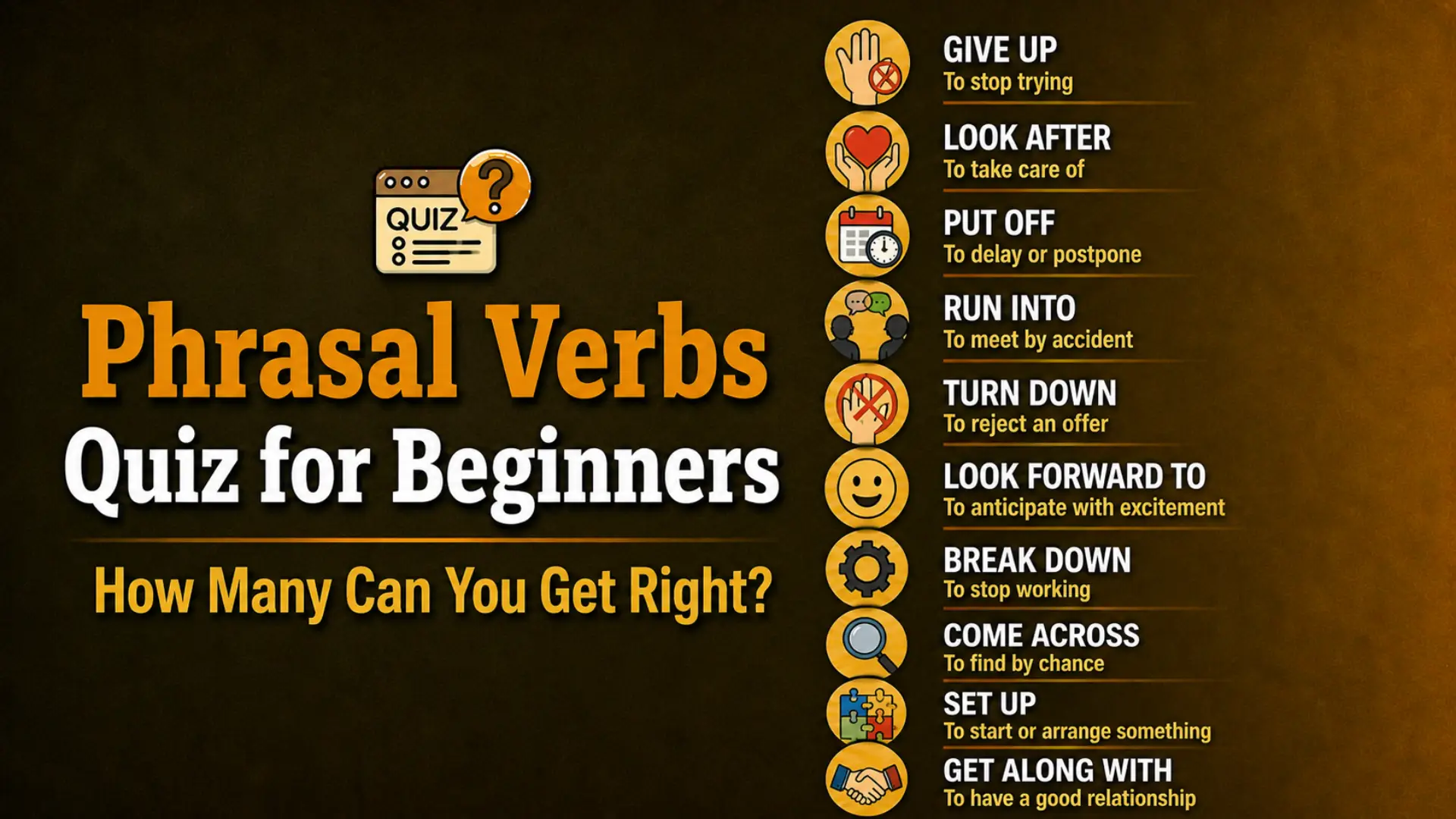
Do you know what “give up”, “look after”, or “put off” really mean in English? If you’re not 100% sure, this phrasal verbs quiz is made just for you! Phrasal verbs are everywhere in everyday English — in movies, conversations, emails, and at work. Yet they are one of the trickiest parts of learning English because one small word can completely change the meaning. That’s exactly why we created this phrasal verbs quiz to help you practise and build confidence.
This quiz has 10 carefully picked questions with 3 options each, so it’s quick, fun, and easy to follow. Every question comes with a clear explanation and a real example sentence — so you don’t just pick the right answer, you actually understand it!
Already feeling good about your English grammar? Then you might also enjoy our Present Perfect vs Past Simple Quiz to sharpen your tenses, or challenge yourself with our Advanced Sentence Structure Quiz if you’re ready for the next level.
But first — let’s see how many phrasal verbs you really know. Scroll down and take the quiz now!
📚 Phrasal Verbs: Complete Study Guide
Master these 10 essential phrasal verbs and use them naturally in everyday English conversations, emails, and real-life situations. Each entry includes meaning, examples, and practical tips to help you go beyond the quiz and truly understand how phrasal verbs work.
GIVE UP – To Stop Trying
'Give up' means to stop trying to do something, usually because it feels too difficult or impossible. It is one of the most commonly used phrasal verbs in everyday English.
Common Collocations: give up + trying / hope / a habit / a dream / smoking
✓ Don't give up — you are almost there!
✓ She gave up smoking after ten years.
✗ Don't give up = Don't continue trying. (incorrect interpretation)
✗ He gave up the prize. (this means he surrendered it — different meaning of give up)
'Give up' can also mean to surrender something (e.g. 'He gave up his seat'). But in most everyday conversations, 'give up' means to stop trying. Context is key with phrasal verbs!
LOOK AFTER – To Take Care Of
'Look after' means to take care of someone or something — making sure they are safe, healthy, or in good condition. It is used for both people and things.
Common Collocations: look after + children / elderly / yourself / a pet / a business
✓ Can you look after my dog while I'm away?
✓ She looked after her elderly parents with great dedication.
✗ She looked after the child from a distance. (watching ≠ taking care of)
✗ He looked after the window. (does not make natural sense — use 'look at' instead)
Look after vs Look at vs Look for. 'Look after' = take care of. 'Look at' = direct your eyes toward. 'Look for' = search for something. These three phrasal verbs look similar but mean completely different things!
PUT OFF – To Delay or Postpone
'Put off' means to delay something to a later time. It implies that a task or event has been pushed back, not cancelled permanently. It is very common in both spoken and written English.
Common Collocations: put off + a meeting / a decision / doing something / a task / an appointment
✓ She keeps putting off her dentist appointment.
✓ The match was put off due to heavy rain.
✗ The match was put off forever. (put off = delay, not cancel permanently)
✗ He put off the document on the table. (wrong — use 'put down' for placing things)
Put off vs Cancel. 'Put off' means to do it later. 'Cancel' means it will not happen at all. Example: 'The event was put off until Friday' vs 'The event was cancelled.' Always choose the right word to avoid confusion!
RUN INTO – To Meet by Accident
'Run into' means to meet someone unexpectedly or by chance — without any plan. It can also mean to encounter a problem or difficulty.
Common Collocations: run into + an old friend / someone / trouble / problems / difficulty
✓ I ran into my old classmate at the airport yesterday.
✓ The project ran into some unexpected problems.
✗ I ran into my friend on purpose. (run into = accidental, not planned)
✗ He ran into the building quickly. (this is literal running — not the phrasal verb meaning)
'Run into' has two main uses — (1) to meet someone by chance, and (2) to encounter a problem. Example: 'I ran into Sarah at the mall' vs 'We ran into difficulties with the project.' Both are very natural in everyday English!
TURN DOWN – To Reject an Offer
'Turn down' means to reject or refuse something such as an offer, invitation, or request. It can also mean to reduce the volume or intensity of something.
Common Collocations: turn down + an offer / a request / an invitation / a job / the volume
✓ He turned down the job offer because it required too much travel.
✓ She turned down the music so we could talk.
✗ He turned down the offer and accepted it. (contradictory — turn down = refuse)
✗ Turn down the volume = increase it. (wrong — turn down = reduce or lower)
Turn down (1) = reject an offer. Turn down (2) = reduce volume or heat. Example: 'She turned down the job' vs 'Please turn down the TV.' The meaning changes with context, so pay attention to what follows the phrasal verb!
LOOK FORWARD TO – To Anticipate with Excitement
'Look forward to' means to feel excited or happy about something that is going to happen in the future. It always uses a noun or a verb in the -ing form after 'to'.
Common Collocations: look forward to + meeting / hearing / seeing / the weekend / a holiday
✓ I'm looking forward to seeing you next week.
✓ We are all looking forward to the concert on Friday.
✗ I'm looking forward to see you. (incorrect — must use -ing form: 'seeing')
✗ I'm looking forward to the bad news. (unnatural — look forward to = positive anticipation)
'Look forward to' is always followed by a noun or verb + -ing. NEVER use the base verb. ✓ 'I look forward to hearing from you.' ✗ 'I look forward to hear from you.' This is one of the most common grammar mistakes in formal emails!
BREAK DOWN – To Stop Working
'Break down' means to stop working or functioning properly — usually used for machines or vehicles. It can also describe a person becoming very emotional, or a situation collapsing.
Common Collocations: break down + (machine) / (car) / (negotiations) / (relationship) / (emotionally)
✓ My laptop broke down right before the presentation.
✓ Negotiations between the two companies broke down last week.
✗ My laptop broke down and worked perfectly. (contradictory — break down = stop working)
✗ The car broke up on the highway. (wrong phrasal verb — use 'broke down' for vehicles)
Break down (1) = machine stops working. Break down (2) = person becomes emotional. Break down (3) = talks or negotiations fail. Example: 'The car broke down.' / 'She broke down in tears.' / 'The peace talks broke down.' One phrasal verb, three powerful uses!
COME ACROSS – To Find by Chance
'Come across' means to find or discover something unexpectedly, without looking for it. It can also mean the impression someone gives to others.
Common Collocations: come across + an article / a document / an old photo / as confident / as rude
✓ I came across this interesting article while browsing online.
✓ She comes across as very confident in interviews.
✗ I came across this article intentionally. (come across = by chance, not on purpose)
✗ I came across the document and threw it away immediately. (unnatural — coming across implies interest or significance)
Come across (1) = find something by chance. Come across (2) = give a certain impression. Example: 'I came across his old letters in the attic.' vs 'He comes across as very professional.' The second use is especially useful in job interviews and professional settings!
SET UP – To Start or Arrange Something
'Set up' means to arrange, establish, or prepare something — such as a business, meeting, system, or equipment. It is very common in professional and business English.
Common Collocations: set up + a business / a meeting / a system / an account / a team
✓ They set up a new company from scratch in just six months.
✓ Can you set up a meeting with the client for Thursday?
✗ They set up the business and immediately closed it. (contradictory context)
✗ She set up quietly in the corner. (wrong — 'set up' needs an object; use 'sat down' here)
'Set up' is one of the most useful phrasal verbs in professional English. You will hear it constantly in business meetings and emails. Common phrases: 'set up a call', 'set up an account', 'set up a project'. Mastering this one phrasal verb can instantly upgrade your business English!
GET ALONG WITH – To Have a Good Relationship
'Get along with' means to have a friendly, comfortable, and positive relationship with someone. It describes how well people interact or co-exist with each other.
Common Collocations: get along with + colleagues / classmates / neighbours / family / people
✓ She gets along with everyone in the office — she's very easy-going.
✓ Do you get along with your new flatmates?
✗ She gets along with her boss but they fight daily. (contradictory — get along with = positive relationship)
✗ He gets along with the project. (wrong — used for people, not tasks; use 'get on with' for tasks)
'Get along with' is more common in American English. In British English, you will often hear 'get on with' instead. Both mean the same thing — to have a good relationship. Example (US): 'I get along with my boss.' Example (UK): 'I get on with my boss.' Great to know both!
⚡ Continue Learning
Grammar Quizzes- Preposition Collocations Quiz – Do You Know Which Preposition Fits?
- English Articles Quiz Part 2: Articles with Places & Names
- English Articles Quiz Part 3: Zero Article & Advanced Rules
- Adverbs Quiz: Test How Well You Use Adverbs in English (10 Questions)
- Comparative Sentences Quiz – Part 2: Pick the Right Form!
