
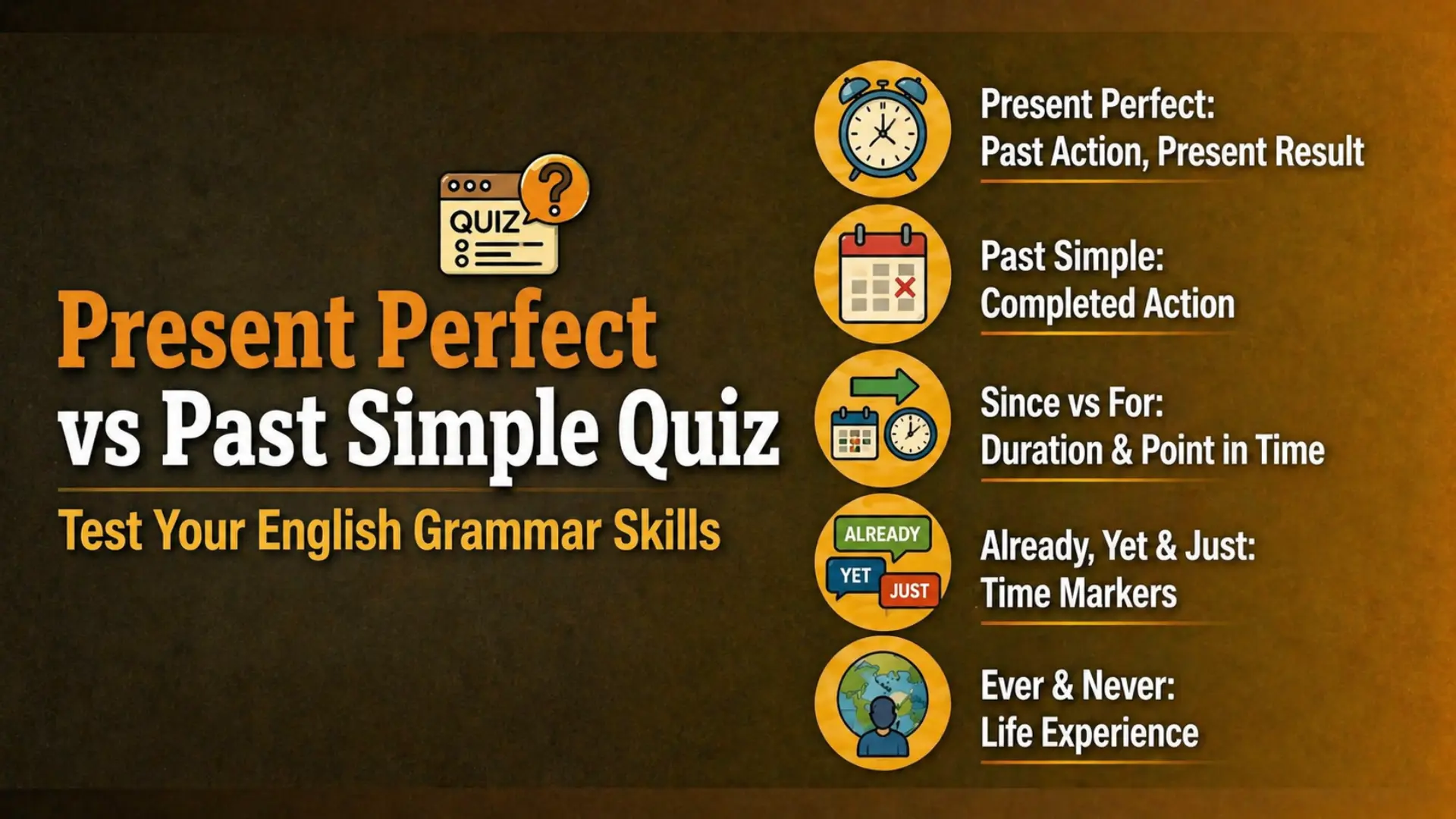
Confused about when to use Present Perfect or Past Simple? You’re not alone! This present perfect vs past simple quiz is designed to help you finally understand the difference — with real sentence examples, clear explanations, and zero confusion.
We use both tenses to talk about the past — but they don’t mean the same thing. One small wrong choice and your sentence sounds unnatural to a native speaker. The good news? Once you see the pattern, it all starts to click.
If you’ve already brushed up on your basics with our Common Grammar Errors Quiz, you’re ready for the next step. And if you want to push your skills even further, our Advanced Sentence Structure Quiz is waiting for you too — but first, let’s tackle this one!
This present perfect vs past simple quiz has 10 real sentence questions — the kind you’d actually use in daily conversation, emails, or exams. Every question comes with a clear explanation so you don’t just pick the right answer, you understand why it’s correct.
No timers. No pressure. Just you, the quiz, and a big grammar win at the end. 🎯
Ready? Let’s find out how well you really know your tenses!
📚 Present Perfect vs Past Simple: Complete Study Guide
Understand when to use present perfect vs past simple with clear rules, real sentence examples, and tips that actually stick.s.
PRESENT PERFECT – Past Action, Present Result
Subject + have/has + past participle
When to use it: Use Present Perfect when a past action has a direct connection to the present moment — the result or effect is still felt now. There is no specific time mentioned.
Common Time Signals: just, already, yet, ever, never, recently, so far, since, for
✓ I my keys. (I don't have them now — present result)
✓ She has never tried sushi before. (life experience up to now)
✗ I my keys yesterday. (wrong — 'yesterday' is a specific past time, use Past Simple)
✗ She has gone to Jaipur last year. (wrong — 'last year' needs Past Simple)
If the sentence has a specific finished time (yesterday, last week, in 2020, an hour ago) — always use Past Simple. If there is no time or the effect is still present — use Present Perfect.
PAST SIMPLE – Completed Action at a Specific Time
Subject + verb (past form)
When to use it: Use Past Simple when an action was completed at a specific, finished point in the past. The time is either stated or clearly understood.
Common Time Signals: yesterday, last week, last year, ago, in 2010, on Monday, at 5pm
✓ She to Jaipur last year. (specific finished time — last year)
✓ I saw that movie last weekend. (specific finished time — last weekend)
✗ She has gone to Jaipur last year. (wrong — 'last year' cannot be used with Present Perfect)
✗ They have had dinner an hour ago. (wrong — 'an hour ago' is a specific past time signal)
Think of Past Simple as a 'closed book' — the action is done and finished. Think of Present Perfect as an 'open book' — the action happened but its effect is still open and relevant now.
SINCE vs FOR – Duration with Present Perfect
have/has + past participle + since (point in time) / for (period of time)
When to use it: Use since with a specific starting point. Use for with a duration or length of time. Both are used with Present Perfect to show something that started in the past and continues now.
Common Collocations: since + 2010 / childhood / Monday / last year | for + five years / a long time / two weeks
✓ I him since childhood. (since = starting point)
✓ We have lived in this city for five years. (for = duration)
✗ I have known him for childhood. (wrong — childhood is a point, not a duration)
✗ We have lived here since five years. (wrong — five years is a duration, not a point)
Ask yourself — is it a starting point or a length of time? Starting point (2010, Monday, childhood) → use since. Length of time (5 years, 3 months, a long time) → use for. Getting this right will instantly improve your grammar accuracy.
ALREADY, YET & JUST – Present Perfect Time Markers
have/has + already/just + past participle | have/has + past participle + yet
When to use it: These three words are almost always used with Present Perfect. Already = action done sooner than expected. Yet = action expected but not done (used in negatives and questions). Just = action completed very recently.
Position in sentence: already/just go after have/has. yet goes at the end of the sentence.
✓ We this project. (done sooner than expected)
✓ He hasn't finished his homework yet. (expected but not done)
✗ We already finished this project. (wrong — missing 'have' with already)
✗ He doesn't finish his homework yet. (wrong — 'yet' needs Present Perfect, not Present Simple)
Many learners use Past Simple with 'already' and 'yet' — this is incorrect in standard British English. Always pair already, yet, and just with Present Perfect (have/has + past participle). Example: 'Did you eat yet?' is informal American English — the correct form is 'Have you eaten yet?'
EVER & NEVER – Life Experience with Present Perfect
Have/Has + subject + ever + past participle? | Subject + have/has + never + past participle
When to use it: Use ever in questions to ask about any time in someone's life up to now. Use never in statements to say something has not happened at any point in someone's life.
Common Collocations: Have you ever + visited / tried / seen / met / been to...
✓ She sushi before. (not at any point in her life)
✓ Have you ever visited London? (at any time in your life?)
✗ She never tried sushi before. (wrong — missing 'has' with never in present context)
✗ Did you ever visit London? (incorrect for a general life experience — use Present Perfect)
'Ever' and 'never' talk about your whole life as one period — from birth up to this moment. That's why they always need Present Perfect. The moment you add a specific time (e.g. 'Did you visit London in 2019?') you switch to Past Simple — because now you're talking about a specific finished time, not your whole life.
⚡ Continue Learning
Grammar Quizzes