
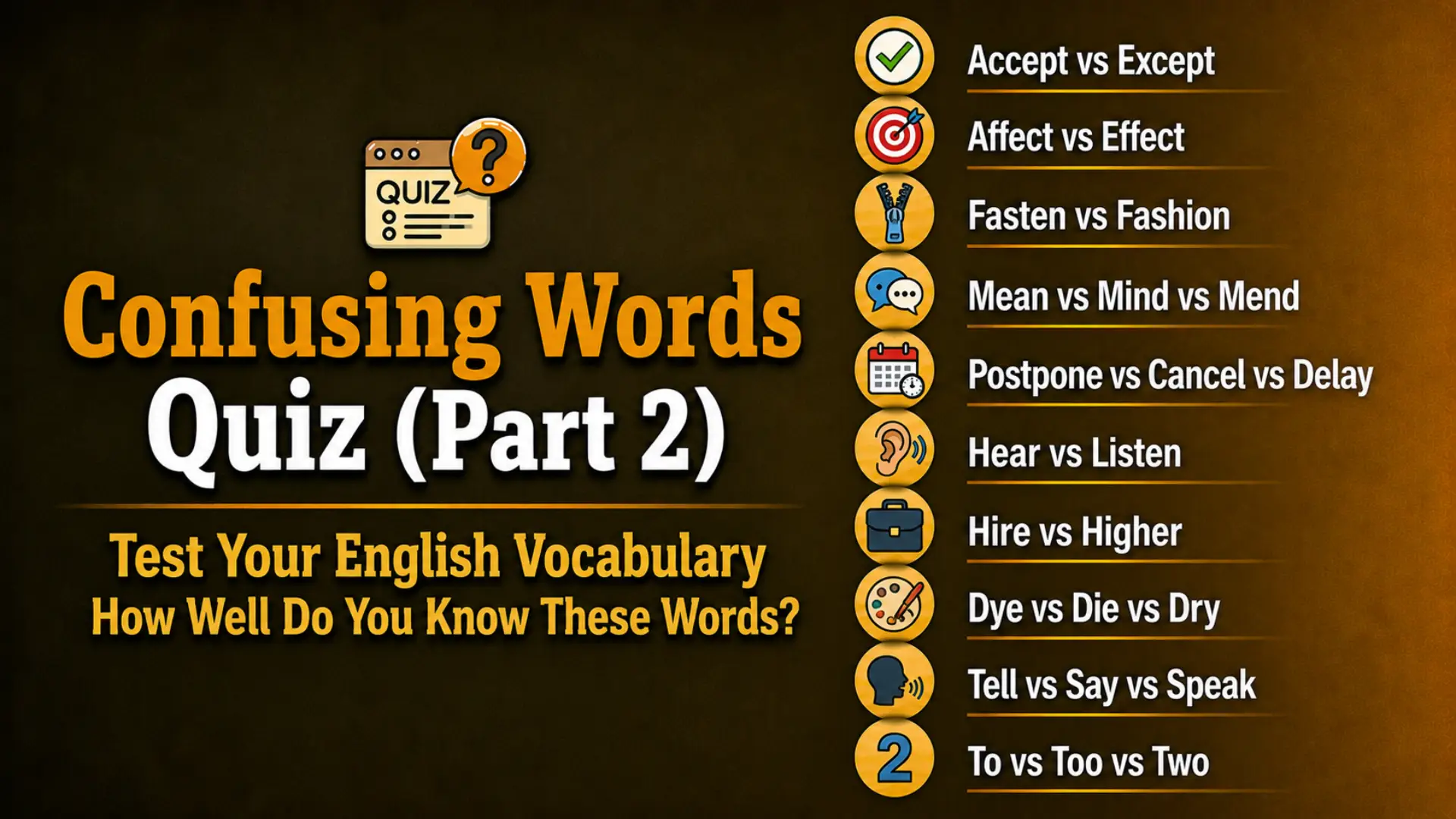
Do you always mix up words like accept and except, or affect and effect? You’re not alone — these are some of the most confusing words in English, and even fluent speakers get them wrong! That’s exactly why we created this confusing words quiz to help you figure out which words trip you up the most.
If you’re just getting started, we recommend checking out Part 1 of this series before diving in here — it covers a different set of tricky word pairs that are equally important to know. We’ve also put together a Phrasal Verbs Quiz for Beginners if you want to keep challenging yourself after this one.
This quiz has 10 carefully picked questions, each one testing a pair or group of words that sound similar but mean very different things. Words like hear vs listen, tell vs say vs speak, and to vs too vs two — these small differences matter a lot in real English communication. Every question comes with a clear explanation so you don’t just guess the answer — you actually learn why it’s correct.
After the quiz, make sure you check out the Study Guide below. It breaks down every word pair covered in this confusing words quiz with rules, real examples, and memory tricks that actually stick. Whether you’re a beginner or an advanced learner, this guide will help you stop second-guessing yourself once and for all.
Ready to find out how well you really know these words? Take the quiz below and see your score!
📚 Confusing Words Quiz: Complete Study Guide
Master these 10 commonly confused English word pairs and never mix them up again. Each entry includes the rule, real examples, and memory tricks to help you choose the right word every time.
ACCEPT vs EXCEPT – Receive or Exclude?
'Accept' is a verb meaning to receive, agree to, or say yes to something. 'Except' is a preposition or conjunction meaning to leave out or exclude. These two words sound similar but have completely different roles in a sentence.
Common Collocations: accept + invitation / offer / responsibility / apology / challenge
✓ He accepted the invitation to the wedding. (agreed to attend)
✓ Everyone was invited except John. (John was left out)
✗ He excepted the invitation. (wrong — 'except' is not used this way)
✗ Everyone was accepted John. (wrong — 'accept' doesn't mean to exclude)
Think of 'Accept' = Agree. Both start with 'A'. Think of 'Except' = Exclude. Both start with 'E'. If you can replace the word with 'agree to', use Accept. If you can replace it with 'excluding', use Except.
AFFECT vs EFFECT – The Action vs The Result
'Affect' is usually a verb meaning to influence or have an impact on something. 'Effect' is usually a noun meaning the result or outcome of something. This is one of the most commonly confused word pairs in English.
Common Collocations: affect + performance / health / mood / results | effect + on / positive / negative / side effect
✓ The rain affected the match. (verb — influenced it)
✓ The movie had a strong effect on me. (noun — result/impact)
✗ The rain effected the match. (wrong — effect is not the verb here)
✗ The movie had a strong affect on me. (wrong — affect is not the noun here)
RAVEN — Remember: Affect is a Verb, Effect is a Noun. This is the most popular trick for this word pair and it works every time! Affect = Action (both start with A). Effect = End result (both start with E).
FASTEN vs FASHION – Secure or Style?
'Fasten' is a verb meaning to close, fix, or secure something firmly in place. 'Fashion' as a verb means to make or shape something. These words look similar but mean completely different things — don't let the spelling fool you!
Common Collocations: fasten + seatbelt / button / zip / lock / strap
✓ Please fasten your seatbelt before takeoff. (secure it)
✓ She fashioned a necklace from old beads. (made/shaped it)
✗ Please fashion your seatbelt. (wrong — fashion doesn't mean to buckle)
✗ She fastened a necklace from old beads. (wrong — fasten doesn't mean to create)
'Fasten' is almost always used with things that need to be buckled, zipped, or locked — seatbelts, buttons, doors. If you're talking about securing something safely, 'fasten' is your word. 'Fashion' in its verb form is rare in everyday speech.
MEAN vs MIND vs MEND – Intent, Object, or Repair?
These three words look and sound slightly similar but serve very different purposes. 'Mean' (to intend), 'Mind' (to object to or be bothered by), and 'Mend' (to repair or fix) are three separate verbs with three separate meanings.
Common Collocations: mean + to do / no harm | mind + the gap / doing something | mend + a relationship / clothes / fences
✓ She didn't mean to hurt your feelings. (didn't intend to)
✓ Do you mind if I open the window? (object to / bothered by)
✓ He mended the broken fence over the weekend. (repaired it)
✗ She didn't mend to hurt your feelings. (wrong — mend means to fix, not intend)
Mean = Intention ("I didn't mean it!"). Mind = Objection ("I don't mind."). Mend = Repair ("Good as new!"). Each word fits a completely different situation — context is the key to choosing the right one.
HEAR vs LISTEN – Passive or Active?
'Hear' is a passive action — it happens naturally without effort when sound reaches your ears. 'Listen' is an active action — you choose to pay attention and focus on what you're hearing. The difference is effort and intention.
Common Collocations: hear + a sound / news / from someone | listen + to music / to a person / carefully
✓ I can't hear what you're saying — speak louder! (the sound isn't reaching my ears)
✓ Please listen carefully when the teacher explains. (pay active attention)
✗ I can't listen what you're saying. (wrong — listen requires 'to' and implies choice)
✗ I love to hear to music every morning. (wrong — it should be 'listen to music')
You HEAR something accidentally. You LISTEN to something on purpose. Example: 'I was listening to music when I heard a loud noise outside.' Notice how both words appear naturally in the same sentence with different roles!
HIRE vs HIGHER – Employ or Elevate?
'Hire' is a verb meaning to employ someone or pay for a service. 'Higher' is the comparative form of the adjective 'high', meaning at a greater level, position, or degree. These two words are homophones — they sound the same but are spelled differently and have completely different meanings.
Common Collocations: hire + employees / staff / a lawyer / a car | higher + level / education / price / ground
✓ The company will hire new employees next month. (employ/recruit)
✓ She is aiming for a higher position in the company. (greater level)
✗ The company will higher new employees. (wrong — higher is not a verb)
✗ She is aiming for a hire position. (wrong — hire is not a comparative adjective)
HIRE contains the word HIM — you hire HIM for the job. HIGHER contains HIGH — think of climbing HIGH-er up a ladder. Homophones like these are best learned by connecting them to their spelling patterns, not just their sound.
POSTPONE vs CANCEL vs DELAY – Not the Same Thing!
These three words are often confused but have important differences. 'Postpone' means to move an event to a later, specific time. 'Cancel' means to call something off completely — it will not happen at all. 'Delay' means to make something happen later than planned, often without a new fixed time.
Common Collocations: postpone + meeting / event / decision | cancel + subscription / flight / plans | delay + flight / payment / response
✓ We should postpone the meeting until Monday. (reschedule it to Monday)
✓ The event was cancelled due to bad weather. (it won't happen at all)
✓ The flight was delayed by two hours. (it happened later than planned)
✗ We should cancel the meeting until Monday. (wrong — cancel means it won't happen, not reschedule)
Postpone = New date planned. Delay = Later, but unclear when. Cancel = Gone completely. If someone says 'the wedding is postponed', there's hope — it's rescheduled. If it's 'cancelled', it's off for good!
DYE vs DIE vs DRY – Color, Death, or Moisture?
'Dye' is a verb meaning to change the color of something using a coloring agent. 'Die' means to stop living or cease to exist. 'Dry' means to remove moisture or become free of liquid. These three words look and sound similar but belong to completely different contexts.
Common Collocations: dye + hair / fabric / clothes | die + of illness / from injury | dry + hair / clothes / dishes
✓ She's going to dye her hair black. (change the color)
✓ The flowers will die without water. (stop living)
✓ Please dry the dishes after washing. (remove moisture)
✗ She's going to die her hair black. (wrong — die means to stop living)
DYE → think of a rainbow of colors (Y looks like a paint drip!). DIE → think of the letter I as a gravestone. DRY → think of a hot sun removing all water. Connecting a word's spelling to a visual image is a powerful memory technique!
TELL vs SAY vs SPEAK – Who Are You Talking To?
'Tell' is used when you share information directly with a person — it always needs an object (someone you are telling). 'Say' is used to express words or thoughts, often without specifying who you're talking to. 'Speak' refers to the act of using your voice or having a conversation.
Common Collocations: tell + someone / a story / the truth | say + something / a word / goodbye | speak + to someone / a language / publicly
✓ Please don't tell the secret to anyone. (share information with a person)
✓ She said goodbye before leaving. (expressed words)
✓ Can you speak more slowly, please? (use your voice)
✗ Please don't say the secret to anyone. (unnatural — say doesn't work with 'secret to someone')
TELL = needs a person after it (tell me, tell him, tell them). SAY = needs words after it (say sorry, say hello, say something). SPEAK = refers to the act of talking (speak English, speak loudly, speak to the manager). When in doubt, ask: am I sharing info with someone? → Use TELL.
TO vs TOO vs TWO – Preposition, Excess, or Number?
These three words are homophones — they all sound the same but are spelled differently and used in completely different ways. 'To' is a preposition or part of an infinitive verb. 'Too' means also or excessively. 'Two' is the number 2.
Common Collocations: to + verb / place | too + adjective / adverb (too tired, too fast) | two + noun (two people, two hours)
✓ He was too tired to continue working. (excessively tired)
✓ I am going to the shop. (preposition showing direction)
✓ I have two brothers. (the number 2)
✗ He was to tired to continue. (wrong — 'to' is not used for excess)
TWO = the number — it has a silent W, just like other number words (whole, wrong). TOO = also or excessive — it has an EXTRA 'o', just like it means EXTRA or ALSO. TO = everything else — preposition and infinitive marker. TOO many O's = TOO much!
⚡ Continue Learning
Quiz