
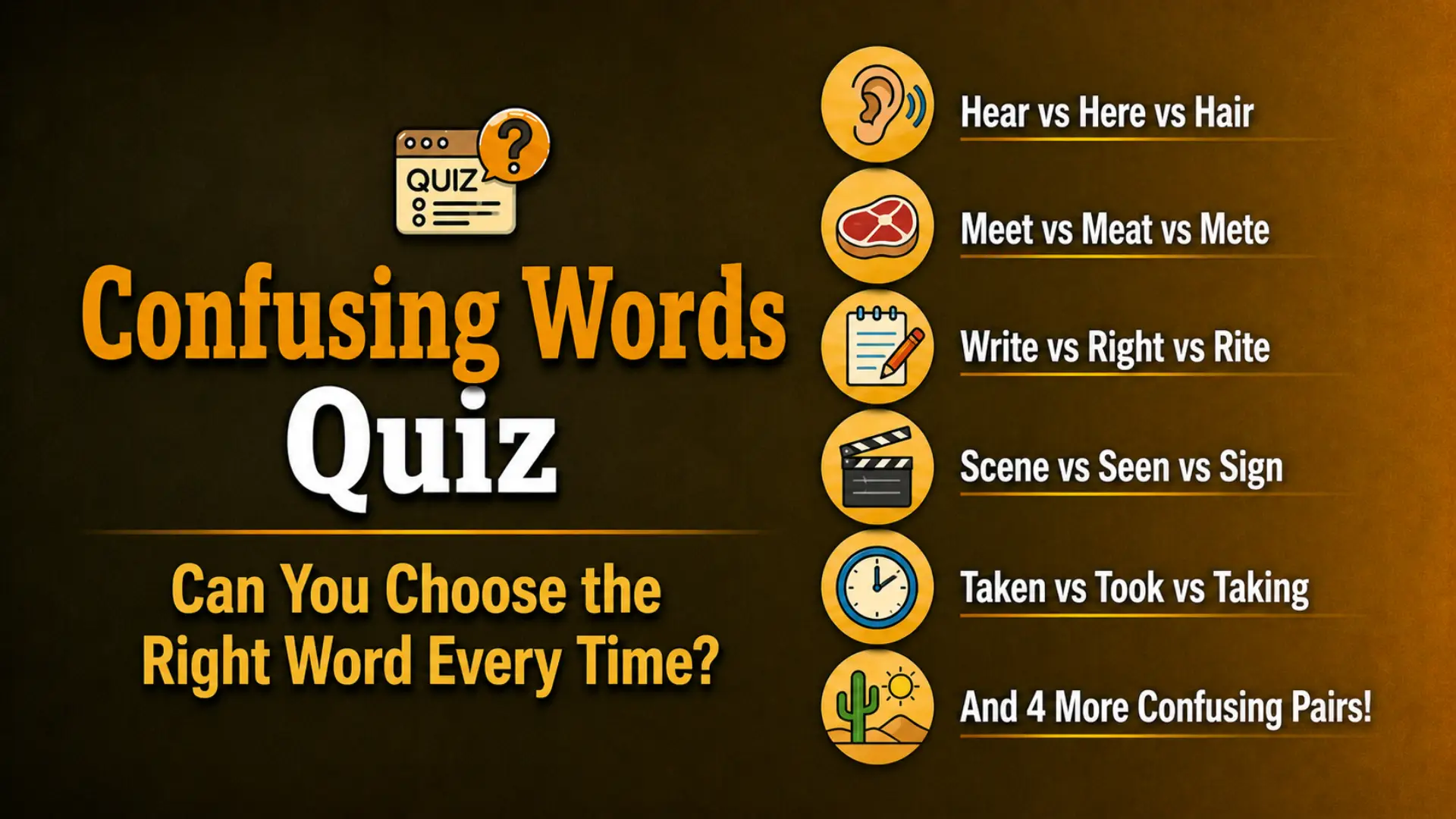
Ever looked at two words and thought — wait, which one do I use here? If yes, you’re in the right place! This confusing words quiz is designed to help you stop second-guessing yourself and start using English with confidence.
Words like hear and here, meet and meat, or write and right — they sound the same but mean completely different things. One wrong choice and your sentence falls apart! Native speakers trip over these too, so don’t worry — you’re in great company.
This confusing words quiz has 10 carefully picked questions, each one targeting the words that English learners mix up the most. Every question comes with a clear explanation so you don’t just guess the answer — you actually understand it.
Before you jump in, if you haven’t already tested yourself on some tricky verb patterns, go check out our Phrasal Verbs Quiz for Beginners — it’s a great warm-up! Already breezing through beginner stuff? Then our Intermediate Phrasal Verbs Quiz is waiting for you.
Now, let’s get back to the main event. Ready to find out how well you really know your confusing words? Scroll down, take the quiz, and let’s see your score!
📚 Confusing Words Quiz: Complete Study Guide
Master these 10 commonly confused English words and never mix them up again. Each word pair includes the rule, real examples, and memory tricks to help you choose the right word every time.
HEAR vs HERE vs HAIR
These are homophones — words that sound the same but have completely different meanings and spellings.
Hear = to perceive sound with your ears (verb)
Here = referring to this place or location (adverb)
Hair = the strands that grow on your head (noun)
✓ Can you the music from outside?
✓ Please come and sit here next to me.
✓ She has long, beautiful hair.
✗ Can you here the music? (wrong — here is a place, not an action)
✗ Come and sit next to me. (wrong — hear is for sound)
Hear contains the word ear — and you use your ear to hear! If it's about sound, look for the ear inside the word.
MEET vs MEAT vs METE
Another set of homophones that confuse even advanced learners. Each word belongs to a completely different category.
Meet = to come together with someone (verb)
Meat = animal flesh used as food (noun)
Mete = to distribute or give out, usually punishment (verb — formal)
✓ I will you at the station at 6 PM.
✓ He doesn't eat meat — he is vegetarian.
✓ The judge will mete out a severe punishment.
✗ I will meat you at the station. (wrong — meat is food, not a verb for meeting)
✗ He doesn't eat . (wrong — meet is for people, not food)
If you are talking about people coming together — use meet. If it's something you eat — use meat. Mete is rarely used in everyday English, so just remember it means to give out something (usually a punishment).
WRITE vs RIGHT vs RITE
Three words, same sound, three very different meanings. These are classic homophones that appear frequently in English writing tests.
Write = to form words or letters on a surface (verb)
Right = correct, or the direction opposite to left (adjective/noun)
Rite = a religious or ceremonial act (noun — formal)
✓ Please your name on the form.
✓ That is the right answer — well done!
✓ The wedding rite was beautiful and traditional.
✗ Please right your name on the form. (wrong — right is not a writing action)
✗ That is the answer. (wrong — write is a verb, not an adjective)
Write starts with W — just like Word. If you are putting words on paper, use write. Right is what you say when someone gets the correct answer!
SCENE vs SEEN vs SIGN
Scene and seen are homophones (same sound), while sign sounds slightly different. All three are commonly mixed up in writing.
Scene = a part of a film, play, or a view in real life (noun)
Seen = past participle of the verb 'see' (verb)
Sign = a symbol, notice, or gesture that gives information (noun/verb)
✓ The opening of the film was breathtaking.
✓ Have you seen the latest episode yet?
✓ There was a no-entry sign on the door.
✗ The opening seen of the film was breathtaking. (wrong — seen is a verb form)
✗ Have you the latest episode? (wrong — scene is a noun, not a verb)
Scene is always a noun — a part of a film or a view. Seen is always used after have / has / had — I have seen, she has seen. If you spot have/has/had before the blank, the answer is always seen!
TAKEN vs TOOK vs TAKING
These are three forms of the verb 'take' — and choosing the right form depends on the tense and sentence structure.
Took = simple past tense (active voice)
Taking = present participle, used in continuous tenses
Taken = past participle, used in perfect tenses and passive voice
✓ She was to the hospital immediately. (passive voice)
✓ He took the medicine this morning. (simple past — active)
✓ She is taking her exam right now. (present continuous)
✗ She was took to the hospital. (wrong — took cannot follow 'was')
✗ She was taking to the hospital. (wrong — 'was taking' needs an object, not a destination)
Whenever you see was / were / is / are / been before the verb, you need the past participle — taken. This is the passive voice pattern: was + past participle. She was taken, he was given, they were told.
WHOLE vs HOLE vs WHILE
Whole and hole are homophones (same sound). While sounds different but is often confused in meaning, especially by learners.
Whole = complete, entire, all of something (adjective)
Hole = an opening or empty space in something (noun)
While = during the time that / a period of time (conjunction/noun)
✓ He read the book in one sitting.
✓ There is a hole in my sock.
✓ She listened to music while cooking dinner.
✗ He read the hole book. (wrong — hole is an opening, not a quantity)
✗ There is a in my sock. (wrong — whole means complete, not a gap)
Think of whole as W + hole — a whole is a hole that has been completely filled up! When you mean everything or complete, use whole. When there's something missing or empty — use hole.
ATTEND vs ATTAIN vs PRETEND
These words look and sound similar but carry very different meanings. This type of confusion is called a near-homophone or confusable — words that are close in sound but not identical.
Attend = to be present at an event or place (verb)
Attain = to achieve or reach a goal through effort (verb)
Pretend = to act as if something is true when it is not (verb)
✓ All staff must the Monday morning meeting.
✓ She worked hard to attain her dream of becoming a doctor.
✓ The children pretended to be superheroes during playtime.
✗ All staff must attain the meeting. (wrong — attain is for goals, not events)
✗ She worked hard to her dream. (wrong — you attend events, not dreams)
Attend + event/meeting/class/school. Attain + goal/success/level/rank. Pretend + to be / that something is true. Learning the word with its natural partner (collocation) helps you never mix them up again!
DESIRE vs DESSERT vs DESERT
These three words are commonly confused because of their similar spelling and sound. Pay close attention to the spelling — one extra letter changes everything!
Desire = a strong feeling of wanting something (noun/verb)
Dessert = a sweet dish eaten after a meal (noun) — double S
Desert = a large dry area of land with little water (noun) / to abandon someone (verb) — single S
✓ She has a strong to travel the world.
✓ We had chocolate cake for dessert.
✓ The Sahara is the world's largest hot desert.
✗ She has a strong dessert to win. (wrong — dessert is a sweet, not a feeling)
✗ We had chocolate cake for desert. (wrong — one S means sand, not sweets!)
DesSert has a double S — just like Sweet Stuff! The more S's, the sweeter it is. Desert (dry land) has one S, just like Sand. And desire? That starts with D-E-S-I — think Deeply I want something!
GROWING vs GROANING vs GROWN
These three words come from different verbs and are confused because of their similar sound. Choosing the right one depends on meaning and grammar structure.
Growing = present participle of 'grow' — increasing in size or developing (verb)
Groaning = present participle of 'groan' — making a deep sound of pain or effort (verb)
Grown = past participle of 'grow' — used in perfect tenses (verb/adjective)
✓ The baby is so fast — she's doubled in size!
✓ He was groaning in pain after the fall.
✓ The children have grown a lot since last year.
✗ The baby is groaning fast. (wrong — groaning is about pain sounds, not getting bigger)
✗ The baby is grown fast. (wrong — grown needs have/has before it)
Is/are + ___ing = present continuous → use growing. Has/have + ___ = present perfect → use grown. Was/were + ___ing = past continuous → use groaning (if about sound). The helping verb before the blank is your biggest clue!
UNDER vs BELOW vs BENEATH
These three prepositions all suggest something is at a lower level, but they are used in different contexts and carry different nuances.
Under = directly below and often covered or in contact (most common, physical use)
Below = at a lower level or position, but not necessarily directly under
Beneath = directly under, but used in more formal or literary contexts
✓ The cat is hiding the bed.
✓ The temperature dropped below zero last night.
✓ She felt the soft grass beneath her feet. (literary/poetic)
✗ The temperature dropped zero. (less natural — below is preferred for measurements)
✗ She felt the grass below her feet. (possible but beneath sounds more natural here)
Use under for everyday physical positions — under the table, under the bridge, under the water. Use below for levels, measurements, and rankings — below average, below zero, below the line. Use beneath when writing formally or creatively — beneath the surface, beneath the stars.
⚡ Continue Learning
Quiz- Advanced English Vocabulary Quiz: C1–C2 Level Words You Must Know
- Present Perfect Tense Quiz: Test Your English Grammar Skills
- Confusing Prepositions Quiz – Can You Pick the Right One?
- Confusing Words Quiz: Test Your English Vocabulary (Part 2)
- Error Detection Quiz: Can You Spot the Mistake? (10 Grammar Questions)
