
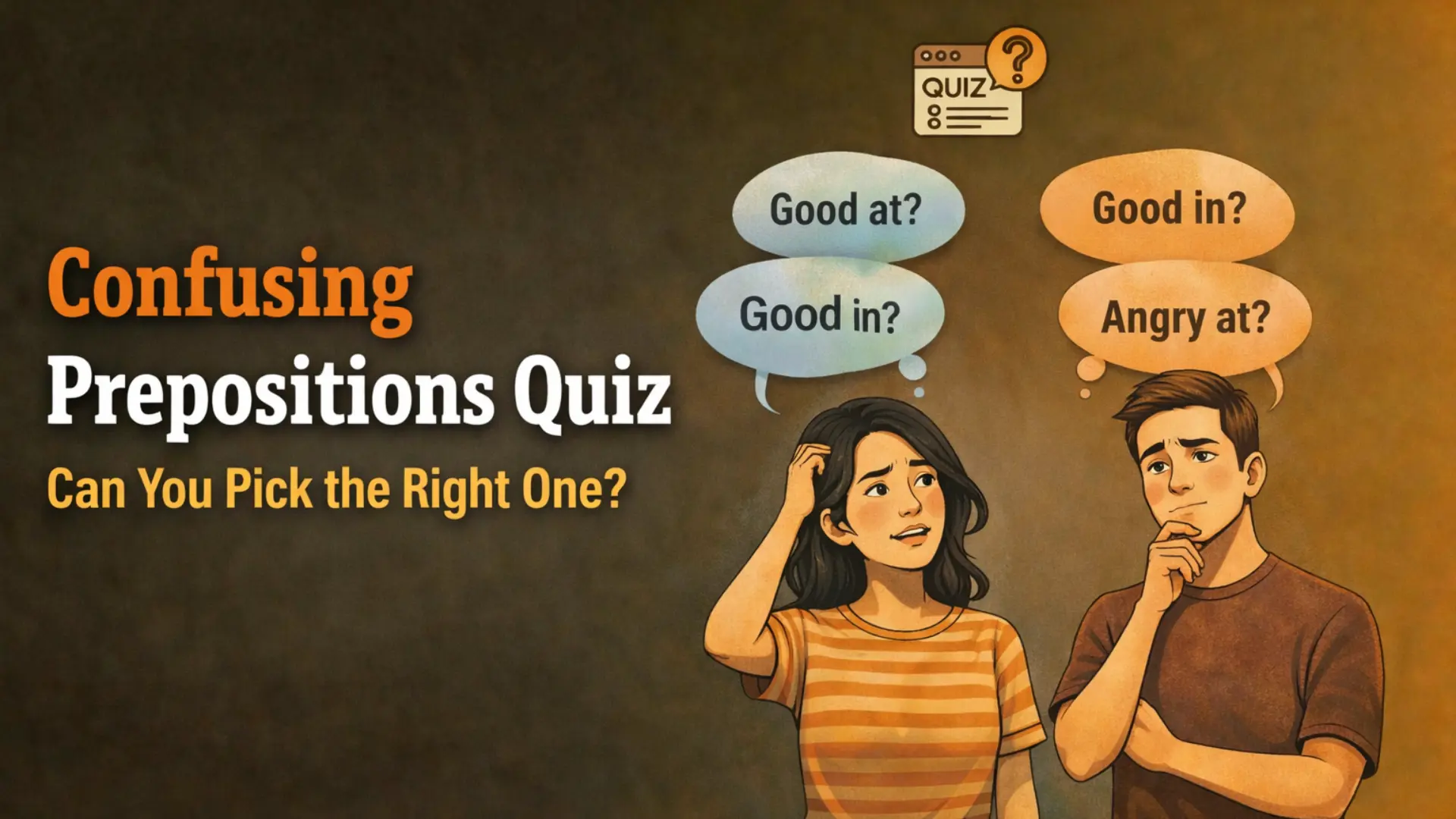
Have you ever written a sentence and stopped to think — wait, is it “good at” or “good in”? Is it “angry with” or “angry at”?
You’re not alone. Confusing prepositions are one of the biggest headaches for English learners — even for people who have been speaking English for years! The tricky part is, these words are small but they carry a lot of meaning. One wrong preposition and your sentence sounds completely off.
The good news? With a little practice, you can get them right every time.
We’ve put together 10 carefully chosen questions that cover the most commonly confused prepositions in everyday English. Each question is followed by a clear explanation and a handy tip so you don’t just guess the answer — you actually learn the rule behind it.
Whether you’re a beginner just starting out or someone brushing up their grammar, this quiz is for you.
So, are you ready to find out how well you really know your prepositions?
📚 Complete Study Guide
Waiting FOR Someone
Always use 'for' after 'wait' when expecting a person or thing to arrive. Use 'wait at' only when describing the location of waiting.
Formula: wait + FOR + person/thing | wait + AT + place
✓ She's been waiting for you since morning
✓ I waited for the bus for 20 minutes
✓ We waited at the restaurant for them
✗ She's been waiting from you (incorrect)
Think of FOR as pointing toward what or who you expect. You wait FOR a person, but wait AT a place.
Good AT a Skill
Use 'at' after 'good' when describing a skill or ability someone has. Use 'good for' when describing benefit or purpose.
Formula: good + AT + skill/activity | good + FOR + benefit/purpose
✓ He's good at playing chess
✓ She's good at mathematics
✓ Vegetables are good for your health
✗ He's good in playing chess (incorrect)
Think of AT as hitting a target — you aim AT a skill to master it. Good AT = ability, Good FOR = benefit.
AT for Specific Times
Use 'at' for exact clock times and specific points in the day. Use 'on' for days and dates, and 'in' for months, seasons, and years.
Time Guide: AT (clock times) | ON (days/dates) | IN (months/years/seasons)
✓ The meeting will start at 9 a.m.
✓ She wakes up at 6 every morning
✓ The event is on Monday / in December
✗ The class starts in 9 a.m. (incorrect)
AT the time, ON the day, IN the month. When you see a clock time, always choose AT.
Congratulate ON an Achievement
Always pair 'congratulate' with 'on' when referring to a specific achievement or success. Use 'congratulate for' only when emphasizing the reason behind the praise.
Formula: congratulate + someone + ON + achievement
✓ They congratulated her on her promotion
✓ We congratulated him on winning the award
✓ She was congratulated on her new job
✗ They congratulated her for her promotion (less natural)
Think of ON as standing ON top of your achievement — you celebrate what someone has reached. Congratulations ON the success!
Angry WITH a Person
Use 'angry with' when your anger is directed at a person. Use 'angry about' when referring to a situation, event, or thing that caused the anger.
Pattern: angry + WITH + person | angry + ABOUT + situation/thing
✓ The teacher was angry with the students for being late
✓ He was angry with his colleague
✓ She was angry about the decision
✗ The teacher was angry on the students (incorrect)
WITH a person, ABOUT a situation. Ask yourself — am I angry at someone or something? That tells you which preposition to use.
Different FROM Something
In standard and formal English, 'different' is followed by 'from'. While 'different to' is acceptable in British English and 'different than' in American English, 'different from' is universally correct.
Formula: different + FROM + noun/pronoun (universally accepted)
✓ The book is different from what I expected
✓ His accent is different from mine
✓ This result is very different from last year's
✗ The book is different than what I expected (less formal)
When in doubt, always use 'different from' — it is accepted in all varieties of English and will never be marked wrong.
Divide INTO Parts
Use 'into' after 'divide' when splitting something into portions or sections. Use 'between' when sharing among two people and 'among' for more than two.
Pattern: divide + INTO + parts/sections | share + BETWEEN (2) / AMONG (3+)
✓ She divided the cake into four equal parts
✓ The class was divided into three groups
✓ The prize was shared between the two winners
✗ She divided the cake in four parts (incorrect)
INTO shows transformation — something whole goes INTO separate pieces. Think of cutting INTO something to divide it.
Apologize FOR an Action
Use 'apologize for' to express regret about an action or behavior. Use 'apologize to' when mentioning the person who receives the apology.
Dual Pattern: apologize + FOR + action/behavior | apologize + TO + person
✓ He apologized for being rude
✓ She apologized to her friend for the misunderstanding
✓ I apologize for the inconvenience
✗ He apologized about being rude (incorrect)
FOR points to the REASON (what you did wrong), TO points to the PERSON (who you wronged). You can use both in one sentence!
Enjoyed this quiz? There’s more where that came from! 🎉 Subscribe to the ClipYourEnglish Newsletter and get fresh English tips every week — right in your inbox. And here’s the best part — every new subscriber gets our free PDF eBook “Idiom Toolbox” as a welcome gift, packed with everyday idioms, simple explanations, and quick exercises to practice what you learn!
⚡ Continue Learning
Grammar Quizzes- Preposition Collocations Quiz – Do You Know Which Preposition Fits?
- Present Perfect vs Past Simple Quiz: Test Your English Grammar Skills
- Intermediate Phrasal Verbs Quiz – How Many Can You Get Right?
- Intermediate English Prepositions Quiz – How Well Do You Know Your Grammar?
- English Articles Quiz Part 1: Basic A, An & The
