
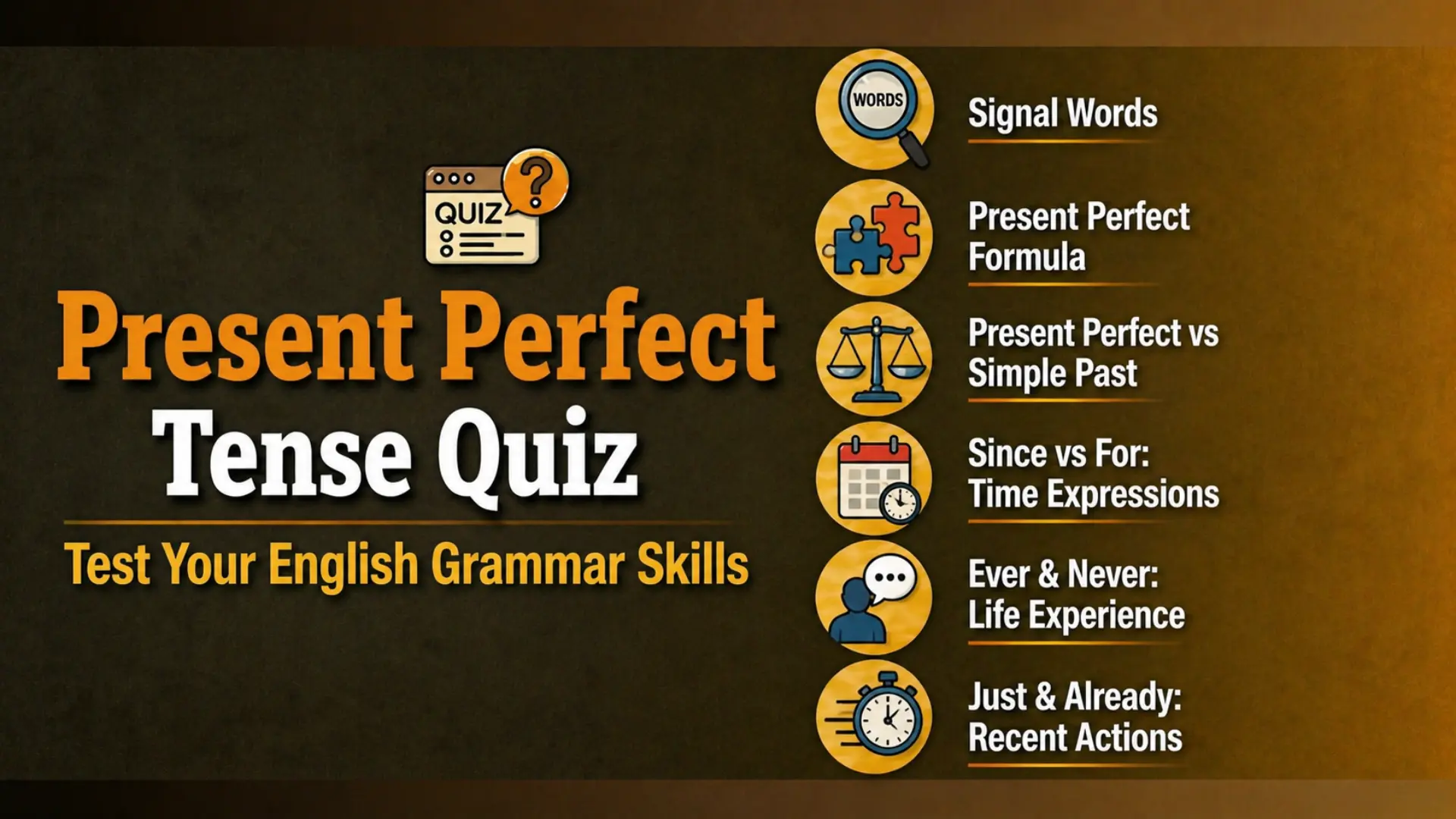
Have you ever said “I went there before” when you actually meant “I have been there before”? You’re not alone! This is one of the most common grammar mistakes English learners make — and that’s exactly why we created this present perfect tense quiz to help you practise and get it right.
The present perfect tense can feel a little confusing, especially knowing when to use have/has + past participle and when to just use the simple past. But here’s the good news — it gets much easier with a little practice!
If you’ve already tested yourself on present perfect vs. past simple, you’ll know how tricky the line between the two tenses can be. This present perfect tense quiz takes it a step further — focusing specifically on the signal words, the patterns, and the real-life sentences that trip most learners up.
This quiz has 10 carefully picked questions covering everyday sentences — the kind you’ll actually use in conversations, emails, and exams. Every question comes with a clear explanation so you don’t just get the right answer, you understand why it’s right.
And if you want an extra challenge after this, check out our Advanced Sentence Structure Quiz to really level up your grammar game.
Ready? Scroll down, take the quiz, and find out how strong your present perfect tense really is. You might just surprise yourself!
📚 Present Perfect Tense: Complete Study Guide
Master the present perfect tense with these 6 essential grammar rules. Each concept includes the formula, real sentence examples, and practical tips to help you stop making mistakes and use this tense with confidence.
SIGNAL WORDS – Your Present Perfect Triggers
Certain words automatically signal that you need the present perfect tense. The most common ones are: already, just, ever, never, before, since, for, yet, so far, recently. When you spot these words in a sentence, your tense choice is present perfect — not simple past.
Common Collocations: have/has + already / just / never / ever + past participle
✓ I have finished my homework.
✓ She has just completed her work.
✓ Have you ever visited Paris?
✗ I already finished my homework. (missing 'have' — incomplete present perfect)
✗ She just completed her work. (informal spoken English only — avoid in writing)
See already, just, ever, never, before, yet in a sentence? Your answer is almost always present perfect. Memorise these signal words and half your present perfect problems disappear instantly!
PRESENT PERFECT FORMULA – Have/Has + Past Participle
Present Perfect = Subject + have/has + past participle. Use 'have' with I, You, We, They. Use 'has' with He, She, It. The past participle is the third form of the verb (go → gone, see → seen, finish → finished).
Structure: I/You/We/They + have + past participle | He/She/It + has + past participle
✓ I him since 2010.
✓ She has finished her work.
✓ He has never seen that movie.
✗ She has finish her work. (wrong — 'finish' must be past participle 'finished')
✗ He have seen that movie. (wrong — use 'has' with He/She/It)
Never use the base form of the verb after have/has. It must always be the past participle. Compare: ✗ 'has finish' vs ✓ 'has finished' — this is one of the most frequent errors in present perfect!
PRESENT PERFECT vs SIMPLE PAST – The Key Difference
Use Simple Past when the sentence mentions a specific finished time (yesterday, last year, in 2010, an hour ago). Use Present Perfect when no specific time is mentioned, or when the action connects to the present (since, for, before, already, just).
Time words that force Simple Past: yesterday / last week / last year / in [year] / ago / this morning (if finished)
✓ She to London last year. (specific past time → Simple Past)
✓ We have visited this place before. (unspecified time → Present Perfect)
✓ They had lunch an hour ago. (specific past time → Simple Past)
✗ She has gone to London last year. (wrong — 'last year' forces Simple Past)
✗ We visited this place before. (technically possible, but 'have visited' is more natural)
If you can see when it happened — use Simple Past. If you only know that it happened (no specific time) — use Present Perfect. This one rule alone will solve most tense confusion!
SINCE vs FOR – Measuring Time in Present Perfect
Use 'since' with a specific point in time (a year, a date, an event). Use 'for' with a duration or period of time (two years, a week, a long time). Both are used with present perfect to show that something started in the past and is still true now.
Pattern: have/has + past participle + since [point in time] | have/has + past participle + for [duration]
✓ I him since 2010. (since = starting point)
✓ We have lived here for two years. (for = duration)
✗ I have known him for 2010. (wrong — 2010 is a point in time, not a duration)
✗ We have lived here since two years. (wrong — 'two years' is a duration, not a point)
Ask yourself — is it a starting point or a length of time? Starting point → since. Length of time → for. Example: since Monday ✓ | for three days ✓ | since three days ✗ | for Monday ✗
EVER & NEVER – Talking About Life Experiences
Use 'ever' in questions to ask about any point in someone's life up to now. Use 'never' in negative sentences to say something has not happened at any point in life. Both are always used with the present perfect, and the word goes between have/has and the past participle.
Pattern: Have/Has + subject + ever + past participle? | Subject + have/has + never + past participle
✓ Have you visited Japan?
✓ He has never seen that movie.
✓ She has never visited London.
✗ He has never saw that movie. (wrong — must use past participle 'seen', not past tense 'saw')
✗ Did you ever visited Japan? (wrong — use 'have' not 'did' with ever in this context)
'Ever' and 'never' always sit between have/has and the past participle — never at the end of the sentence. ✓ 'He has never seen it' | ✗ 'He has seen it never'. Get the word order right and your sentence will always sound natural!
JUST & ALREADY – Very Recent Actions
Use 'just' to talk about something that happened a very short time ago. Use 'already' to say something happened sooner than expected or before a certain point. Both go between have/has and the past participle in British English.
Pattern: Subject + have/has + just/already + past participle
✓ I done my homework.
✓ She has just finished her work.
✓ We have just arrived.
✗ I already have done my homework. (wrong word order — 'already' must follow have/has)
✗ She has finished just her work. (wrong — 'just' must come before the past participle)
The correct order is always have/has → just/already → past participle. Think of it as a fixed sandwich: the signal word is always the filling in the middle. ✓ 'has just finished' ✓ 'have already done' — never break this order!
⚡ Continue Learning
Grammar Quizzes