
Do you know when to use the, a, or… nothing at all?
If you aced our English Articles Quiz Part 1, you already know the basics — but here’s where it gets really interesting. When it comes to places and proper names, English articles follow their own set of rules, and even fluent speakers get tripped up by them.
Why does the show up before the Eiffel Tower but disappear before Mount Everest? Why do we say the Netherlands but simply India? These aren’t random — there’s a logic behind every choice, and once you crack it, your English will sound dramatically more natural.
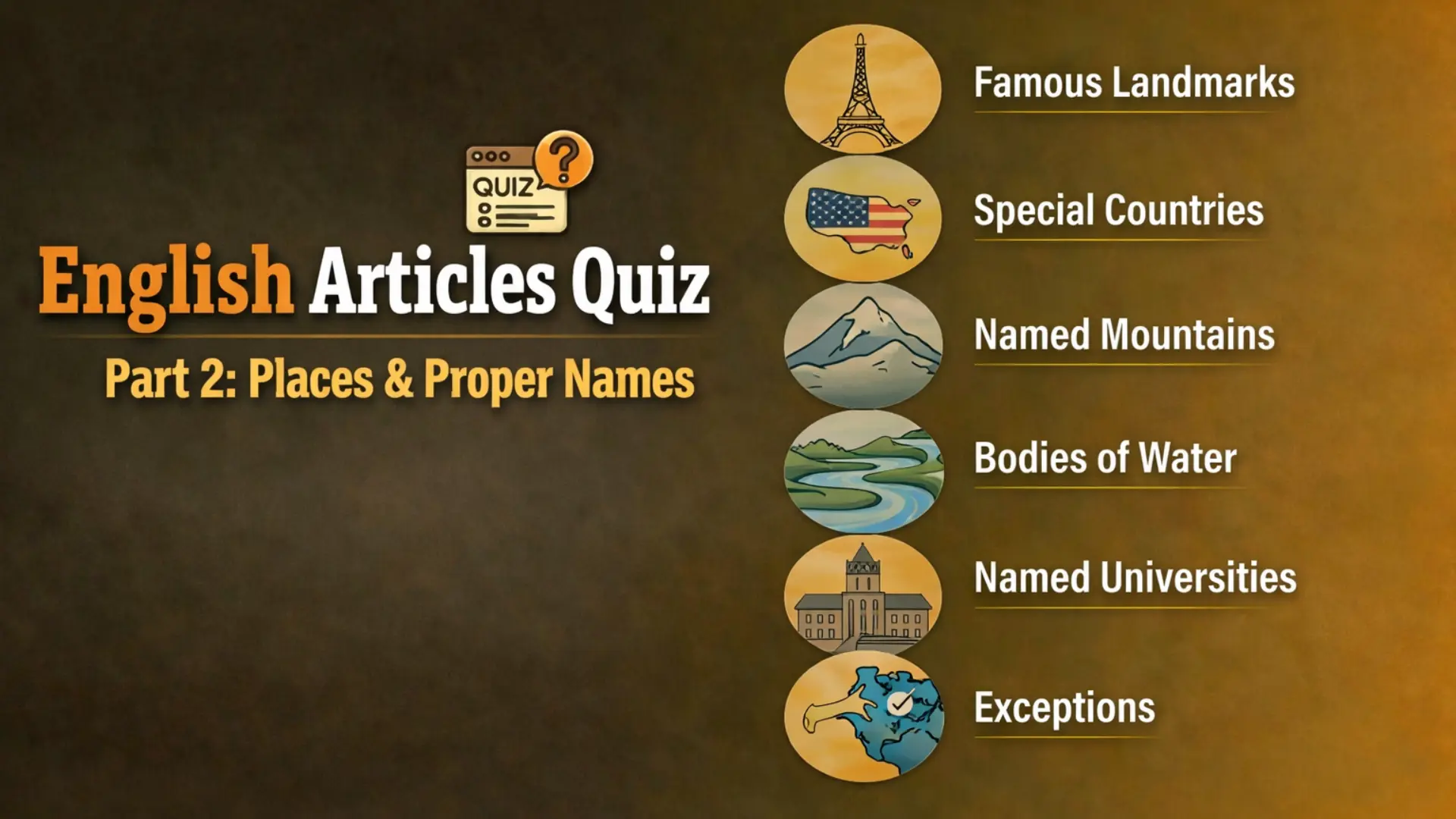
That’s exactly what Part 2 of our English Articles Quiz is designed for. This round focuses specifically on articles with places and names — monuments, countries, mountains, rivers, and more. With 10 carefully crafted questions, detailed explanations, and easy-to-remember rules, you won’t just pick the right answer — you’ll actually get why it’s right.
Whether you’re a grammar enthusiast, a student preparing for an exam, or just someone who wants to stop second-guessing themselves mid-sentence — this quiz is for you.
Think you’ve got it figured out? Let’s put that to the test! 👇
📚 Complete Study Guide
Master Articles A, An & The — One Rule at a Time
THE with Famous Landmarks & Monuments
Use 'the' before the names of famous landmarks, monuments, and unique man-made structures. Since there is only one of these in the world, 'the' signals that everyone knows exactly which one you mean.
Formula: the + landmark/monument name
✓ We visited the Eiffel Tower last summer.
✓ The Taj Mahal is a symbol of love.
✓ Have you seen the Colosseum in Rome?
✗ We visited Eiffel Tower last summer. (incorrect)
If there is only ONE of it in the entire world and it has a proper name, it almost certainly takes 'the'. Think: the Great Wall, the Statue of Liberty, the Pyramids.
THE with Special Country Names
Most country names take NO article. However, use 'the' before countries whose names include a common noun (States, Kingdom, Republic) or that are plural in form.
Pattern: No article → India, France, Japan | Use 'the' → the United States, the Netherlands, the Philippines
✓ She is traveling to the United States.
✓ He lives in the Netherlands.
✓ They visited the Maldives.
✗ She is traveling to United States. (incorrect)
Does the country name sound plural or contain a word like 'United,' 'Republic,' or 'Kingdom'? If yes, add 'the'. When in doubt, check — these are best memorized as a group.
NO Article with Named Mountains
Individual named mountains do not take any article. However, mountain ranges (groups of mountains) always take 'the'.
Pattern: No article → Mount Everest, Mount Fuji | Use 'the' → the Himalayas, the Alps, the Rockies
✓ They climbed Mount Everest in 2019.
✓ She went to the Himalayas for trekking.
✓ Mount Kilimanjaro is in Tanzania.
✗ They climbed the Mount Everest. (incorrect)
One mountain = no article. A range of mountains = 'the'. Think: Mount Fuji (alone) vs. the Andes (a whole range).
THE with Bodies of Water
Always use 'the' before the names of oceans, seas, rivers, canals, and gulfs. This is one of the most consistent article rules in English.
Formula: the + ocean/sea/river/canal name
✓ We sailed across the Pacific Ocean.
✓ We stayed near the River Thames.
✓ The Amazon River flows through Brazil.
✗ We sailed across Pacific Ocean. (incorrect)
Unlike mountains or countries, ALL named bodies of water use 'the' — always. The Atlantic, the Nile, the Red Sea, the English Channel — no exceptions.
NO Article with Named Universities
When a university's name begins with its own proper name, no article is needed. However, when the name starts with 'University of...', use 'the'.
Pattern: No article → Oxford University, Harvard University | Use 'the' → the University of Oxford, the University of Michigan
✓ She studied at Oxford University.
✓ He graduated from Harvard University.
✓ She enrolled at the University of Cambridge.
✗ She studied at the Oxford University. (incorrect)
Does 'University' come AFTER the name? → No article (Oxford University). Does 'University' come BEFORE the name? → Use 'the' (the University of Oxford). Same institution, different grammar!
NO Article with Most Country Names
The majority of country names are used without any article. These are treated as unique proper nouns that stand alone — no 'the', no 'a'.
Formula: No article + country name (for most countries)
✓ He is from India.
✓ She lives in Japan.
✓ They are visiting France next year.
✗ He is from the India. (incorrect)
If a country name is a single, simple proper noun — no article needed. Save 'the' for special cases like the United States or the Netherlands (see the rule above).
Enjoyed this quiz? There’s more where that came from! 🎉 Subscribe to the ClipYourEnglish Newsletter and get fresh English tips every week — right in your inbox. And here’s the best part — every new subscriber gets our free PDF eBook “Idiom Toolbox” as a welcome gift, packed with everyday idioms, simple explanations, and quick exercises to practice what you learn!
⚡ Continue Learning
Grammar Quizzes- Present Perfect Tense Quiz: Test Your English Grammar Skills
- Basic English Prepositions Quiz – Test Your Grammar Fundamentals
- Intermediate Phrasal Verbs Quiz – How Many Can You Get Right?
- Error Detection Quiz: Can You Spot the Mistake? (10 Grammar Questions)
- Phrasal Verbs Quiz for Beginners – How Many Can You Get Right?

It is good
Thank you, don’t forget to explore all quizzes and blog post 😊.