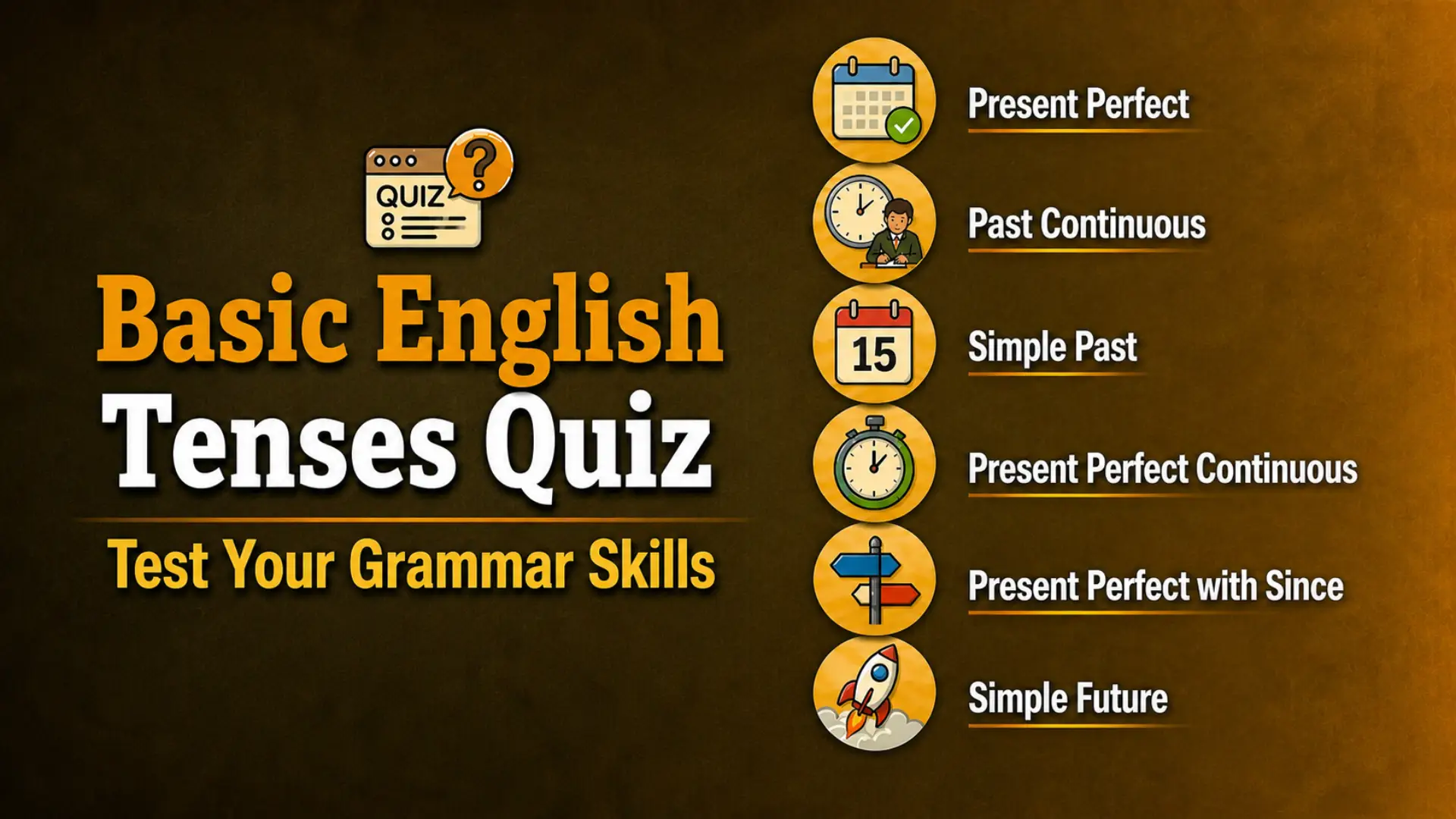
Are you ready to take the Basic English Tenses Quiz and find out how well you really know your grammar? Do you always second-guess yourself when choosing between “I have seen” and “I saw”? Or does “was sleeping” vs “slept” ever confuse you? Don’t worry — tenses are one of the trickiest parts of English, and almost every learner struggles with them at some point!
The good news? With a little practice, tenses become second nature. And that’s exactly why we built this Basic English Tenses Quiz — to help you figure out where you stand and what to improve.
This quiz has 10 simple, real-world questions covering the most common English tenses — present, past, and future. Each question is short, clear, and comes with a detailed explanation so you don’t just guess the answer — you actually learn from it.
If you’ve already tested yourself on our Present Perfect vs Past Simple Quiz, you know how eye-opening these small grammar checks can be. And if tenses like the present perfect still feel a little shaky, our Present Perfect Tense Quiz is a great follow-up after this one!
Whether you’re a beginner just starting out or someone brushing up on the basics — this basic English tenses quiz is for you. It takes less than 5 minutes, and by the end, you’ll know exactly which tenses to focus on.
So, are you ready to find out how good your English tenses really are? 👇 Take the quiz below and see your score!
📚 Basic English Tenses: Complete Study Guide
Master these 6 essential English tenses and never second-guess your grammar again. Each tense includes the formula, real-life examples, and practical tips to help you use them correctly every time.
PRESENT PERFECT – Have/Has + Past Participle
Subject + have/has + past participle
Use the Present Perfect for experiences or actions that happened at an unspecified time before now. Key signal words: already, ever, never, before, since, just.
✓ I this movie before. (experience before now)
✓ She has already left. (completed very recently)
✗ I saw this movie before. (wrong — no specific time mentioned)
✗ She have already left. (wrong — use 'has' with she/he/it)
Use have with I / We / You / They. Use has with He / She / It. The word 'before' or 'already' in a sentence is a strong signal to use Present Perfect!
PAST CONTINUOUS – Was/Were + Verb-ing
Subject + was/were + verb-ing
Use the Past Continuous for an action that was in progress at a specific moment in the past, or when another action interrupted it. Key signal words: when, while, at that time.
✓ She when I called her. (in progress when interrupted)
✓ They were having dinner when I arrived. (ongoing when another action happened)
✗ She slept when I called her. (wrong — suggests she went to sleep after the call)
✗ They had dinner when I arrived. (wrong — suggests it was completed, not in progress)
Past Continuous + when + Simple Past. The longer background action uses Past Continuous. The shorter interrupting action uses Simple Past. Example: She was cooking when the phone rang.
SIMPLE PAST – Verb in Past Form
Subject + past form of verb (regular: +ed / irregular: varies)
Use the Simple Past for actions that were completed at a specific time in the past. Key signal words: yesterday, last week, ago, in 2020.
✓ He the exam last week. (completed action, specific time)
✓ I saw him at the station yesterday.
✗ He takes the exam last week. (wrong — present tense with past time word)
✗ He taken the exam last week. (wrong — past participle without auxiliary verb)
take → took, see → saw, go → went, have → had, come → came. When you see time expressions like 'last week', 'yesterday', or 'ago', always use Simple Past — never Present Perfect!
PRESENT PERFECT CONTINUOUS – Have/Has Been + Verb-ing
Subject + have/has + been + verb-ing
Use the Present Perfect Continuous to show an action that started in the past and is still ongoing, especially when you want to emphasize the duration. Key signal words: for, since, all day, how long.
✓ We for an hour. (started in the past, still waiting now)
✓ I have been studying English since 2020.
✗ We were waiting for an hour. (wrong — suggests it ended in the past)
✗ We are waiting for an hour. (wrong — present continuous, no past connection)
Use for with a duration (for an hour, for two years). Use since with a starting point (since 2020, since Monday). Both are commonly used with Present Perfect and Present Perfect Continuous tenses.
PRESENT PERFECT with SINCE – Has/Have + Lived
Subject + has/have + past participle + since + starting point
Use the Present Perfect with 'since' when an action or state started at a specific point in the past and continues up to now. This is different from Simple Past, which describes a finished action.
✓ He here since 2020. (started in 2020, still lives here now)
✓ She has worked at this company since June.
✗ He lived here since 2020. (wrong — Simple Past suggests he no longer lives here)
✗ He is living here since 2020. (wrong — Present Continuous cannot be used with 'since' this way)
Ask yourself — Is the action still happening now? If yes, use Present Perfect (has/have + past participle). If the action is finished and in the past, use Simple Past. This one question will help you choose the right tense every time!
SIMPLE FUTURE – Will + Base Verb
Subject + will + base form of verb
Use the Simple Future with 'will' for decisions made at the moment of speaking, predictions, promises, and future plans. Key signal words: tomorrow, next week, soon, in the future.
✓ I him tomorrow. (future plan)
✓ It will rain tomorrow. (prediction)
✗ I meet him tomorrow. (wrong — base verb alone cannot express future)
✗ I met him tomorrow. (wrong — past tense with a future time word)
Use will for spontaneous decisions and predictions. Use going to for plans already decided. Example: 'I will help you!' (decided right now) vs 'I am going to visit Paris next month.' (already planned). Both are correct future forms!
⚡ Continue Learning
Grammar Quizzes- English Articles Quiz Part 2: Articles with Places & Names
- English Articles Quiz Part 1: Basic A, An & The
- Present Perfect Tense Quiz: Test Your English Grammar Skills
- Basic English Prepositions Quiz – Test Your Grammar Fundamentals
- Preposition Collocations Quiz – Do You Know Which Preposition Fits?
